﷽
Before there was a river that split faithful men from faltering ones, before there was a small band standing in the open field against an army they could not outnumber, there was a people who had grown so weak under occupation that they finally admitted, out loud, that they needed a king.
A People Who Asked for What They Could Not Handle
Sūrah al-Baqarah takes us back to Banī Isrā’īl after Mūsā ʿalayhissalām, their land overrun, their sons killed or taken captive, their strength broken by an enemy they no longer had the will to resist. They came to their prophet, identified by Ibn Kathīr raḥimahullāh in his commentary on Sūrah al-Baqarah (2:246) as Shamwīl (Samuel), with a demand.
إِذْ قَالُوا لِنَبِيٍّ لَّهُمُ ابْعَثْ لَنَا مَلِكًا نُّقَاتِلْ فِي سَبِيلِ اللَّهِ
Idh qālū li-nabiyyil-lahumub-ʿath lanā malikan nuqātil fī sabīlillāh.
“When they said to a prophet of theirs, ‘Send us a king, and we will fight in the way of Allāh.'”
— Sūrah al-Baqarah (2:246)
Their own prophet, knowing his people better than they knew themselves, warned them plainly before granting the request.
قَالَ هَلْ عَسَيْتُمْ إِن كُتِبَ عَلَيْكُمُ الْقِتَالُ أَلَّا تُقَاتِلُوا
Qāla hal ʿasaytum in kutiba ʿalaykumul-qitālu allā tuqātilū?
“He said, ‘Is it not possible that if fighting was prescribed for you, you would not fight?'”
— Sūrah al-Baqarah (2:246)
قَالُوا وَمَا لَنَا أَلَّا نُقَاتِلَ فِي سَبِيلِ اللَّهِ وَقَدْ أُخْرِجْنَا مِن دِيَارِنَا وَأَبْنَائِنَا
Qālū wa mā lanā allā nuqātila fī sabīlillāhi wa qad ukhrijnā min diyārinā wa abnā’inā.
“They said, ‘And why should we not fight in the cause of Allāh when we have been driven out from our homes and from our children?'”
— Sūrah al-Baqarah (2:246)
Allāh ʿazza wa jall then tells us plainly what happened when the promise was actually tested.
فَلَمَّا كُتِبَ عَلَيْهِمُ الْقِتَالُ تَوَلَّوْا إِلَّا قَلِيلًا مِّنْهُمْ
Fa-lammā kutiba ʿalayhimul-qitālu tawallaw illā qalīlam-minhum.
“But when fighting was prescribed for them, they turned away, except a few of them.”
— Sūrah al-Baqarah (2:246)
Notice how early this word arrives. Qalīlam-minhum, a few of them. Long before the river, long before the battlefield, the sūrah has already told us that the story we are about to read is a story about a small remainder. As Ibn Kathīr raḥimahullāh notes in his commentary on this āyah, this is precisely the pattern of a people who ask boldly for what they are not yet prepared to carry, and then discover the size of their own resolve only once the cost becomes real.
A King They Did Not Want
Their prophet then delivered the answer to their original request.
وَقَالَ لَهُمْ نَبِيُّهُمْ إِنَّ اللَّهَ قَدْ بَعَثَ لَكُمْ طَالُوتَ مَلِكًا
Wa qāla lahum nabiyyuhum innal-lāha qad baʿatha lakum Ṭālūta malikā.
“And their prophet said to them, ‘Indeed, Allāh has sent to you Ṭālūt as a king.'”
— Sūrah al-Baqarah (2:247)
The response was immediate objection.
قَالُوا أَنَّىٰ يَكُونُ لَهُ الْمُلْكُ عَلَيْنَا وَنَحْنُ أَحَقُّ بِالْمُلْكِ مِنْهُ وَلَمْ يُؤْتَ سَعَةً مِّنَ الْمَالِ
Qālū annā yakūnu lahul-mulku ʿalaynā wa naḥnu aḥaqqu bil-mulki minhu wa lam yu’ta saʿatam-minal-māl.
“They said, ‘How can he have kingship over us while we are more worthy of kingship than him, and he has not been given any measure of wealth?'”
— Sūrah al-Baqarah (2:247)
Notice what this objection actually is. Their prophet had not offered Ṭālūt as a suggestion open to debate. He had said it plainly: innal-lāha qad baʿatha lakum Ṭālūta malikā, “indeed, Allāh has sent to you Ṭālūt as a king.” Once a matter has been conveyed as settled by Allāh ʿazza wa jall through His prophet, it is no longer available for a believer’s own weighing and preference, however reasonable that preference might feel:
وَمَا كَانَ لِمُؤْمِنٍ وَلَا مُؤْمِنَةٍ إِذَا قَضَى اللَّهُ وَرَسُولُهُ أَمْرًا أَن يَكُونَ لَهُمُ الْخِيَرَةُ مِنْ أَمْرِهِمْ ۗ وَمَن يَعْصِ اللَّهَ وَرَسُولَهُ فَقَدْ ضَلَّ ضَلَالًا مُّبِينًا
Wa mā kāna li-mu’miniw-wa lā mu’minatin idhā qaḍallāhu wa rasūluhū amran ay-yakūna lahumul-khiyaratu min amrihim, wa may-yaʿṣillāha wa rasūlahū faqad ḍalla ḍalālam-mubīnā.
“It is not for a believing man or a believing woman, when Allāh and His Messenger have decided a matter, that they should have any choice about their affair. And whoever disobeys Allāh and His Messenger has certainly strayed into clear error.”
— Sūrah al-Aḥzāb (33:36)
This is why “how can he have kingship over us” is not a small lapse. It is the same objection Iblīs raised first, in substance if not in scale, when he weighed his own criteria against a command already given and found himself, in his own eyes, the more deserving:
قَالَ أَنَا خَيْرٌ مِّنْهُ خَلَقْتَنِي مِن نَّارٍ وَخَلَقْتَهُ مِن طِينٍ
Qāla anā khayrum-minhu khalaqtanī min nāriw-wa khalaqtahū min ṭīn.
“He said, ‘I am better than him. You created me from fire and created him from clay.'”
— Sūrah al-Aʿrāf (7:12)
Banī Isrā’īl measured by wealth and lineage. Iblīs measured by substance. Different currency, same transaction: a creature placing its own standard above a decree Allāh ʿazza wa jall had already issued. He does not love this in either of them, or in us:
إِنَّهُ لَا يُحِبُّ الْمُسْتَكْبِرِينَ
Innahū lā yuḥibbul-mustakbirīn.
“Indeed, He does not like the arrogant.”
— Sūrah an-Naḥl (16:23)
And in another verse:
وَٱسْمَعُوا۟ ۗ وَٱللَّهُ لَا يَهْدِى ٱلْقَوْمَ ٱلْفَـٰسِقِينَ
Wasmāʿū, wallāhu lā yahdī l-qawmal-fāsiqīn.
“and Allāh does not guide the defiantly disobedient people.”
— Sūrah al-Ma’idah (5:108)
Ibn Kathīr raḥimahullāh explains in his commentary on this āyah that Ṭālūt was not a descendant of the family that had historically produced kings among Banī Isrā’īl, and by the standard they were measuring with, he was also poor. Their prophet’s answer names the two things that were given to him instead.
قَالَ إِنَّ اللَّهَ اصْطَفَاهُ عَلَيْكُمْ وَزَادَهُ بَسْطَةً فِي الْعِلْمِ وَالْجِسْمِ
Qāla innal-lāhaṣ-ṭafāhu ʿalaykum wa zādahū basṭatan fil-ʿilmi wal-jism.
“He said, ‘Indeed, Allāh has chosen him over you and increased him abundantly in knowledge and stature.'”
— Sūrah al-Baqarah (2:247)
Not wealth. Not lineage. ʿIlm and jism, discernment and physical capacity, the two things that actually determine whether a leader can carry a people through what is coming, and the two things Banī Isrā’īl had not thought to ask about at all. Their prophet closes the objection with a single line that settles every argument of pedigree ever raised against a choice Allāh ʿazza wa jall has already made.
وَاللَّهُ يُؤْتِي مُلْكَهُ مَن يَشَاءُ
Wallāhu yu’tī mulkahū mai-yashā’.
“And Allāh gives His kingship to whom He wills.”
— Sūrah al-Baqarah (2:247)
Still unconvinced, they asked for a sign, and Allāh ʿazza wa jall gave them one that reached directly into their own history.
وَقَالَ لَهُمْ نَبِيُّهُمْ إِنَّ آيَةَ مُلْكِهِ أَن يَأْتِيَكُمُ التَّابُوتُ فِيهِ سَكِينَةٌ مِّن رَّبِّكُمْ
Wa qāla lahum nabiyyuhum inna āyata mulkihī ay-ya’tiyakumut-tābūtu fīhi sakīnatum-mir-Rabbikum.
“And their prophet said to them, ‘Indeed, a sign of his kingship is that the chest will come to you, in it a sense of security from your Lord.'”
— Sūrah al-Baqarah (2:248)
Ibn Kathīr raḥimahullāh explains in his commentary on this āyah that this was the Tābūt, the wooden chest that had carried the barakah of Mūsā and Hārūn ʿalayhimassalām before them, lost when their enemies had overwhelmed them and taken it away. Now Allāh ʿazza wa jall commanded the angels to carry it back and set it at Ṭālūt’s own door, in full view of the very people who had doubted him. Every step of this foundation, before a single arrow was drawn, was Allāh ʿazza wa jall answering a small and hesitant people’s own objections with a proof they could not argue past.
The River That Told the Truth
With the sign accepted, Ṭālūt marched out with his army, and immediately Allāh ʿazza wa jall set a second test before the first battle had even begun.
فَلَمَّا فَصَلَ طَالُوتُ بِالْجُنُودِ قَالَ إِنَّ اللَّهَ مُبْتَلِيكُم بِنَهَرٍ فَمَن شَرِبَ مِنْهُ فَلَيْسَ مِنِّي وَمَن لَّمْ يَطْعَمْهُ فَإِنَّهُ مِنِّي إِلَّا مَنِ اغْتَرَفَ غُرْفَةً بِيَدِهِ
Fa-lammā faṣala Ṭālūtu bil-junūdi qāla innal-lāha mubtalīkum bi-naharin fa-man shariba minhu fa-laysa minnī wa mal-lam yaṭʿamhu fa-innahū minnī illā manighṭarafa ghurfatam bi-yadih.
“Then when Ṭālūt set out with the soldiers, he said, ‘Indeed, Allāh will be testing you with a river. So whoever drinks from it is not of me, and whoever does not taste it is indeed of me, excepting one who takes a small handful.'”
— Sūrah al-Baqarah (2:249)
فَشَرِبُوا مِنْهُ إِلَّا قَلِيلًا مِّنْهُمْ
Fa-sharibū minhu illā qalīlam-minhum.
“But they drank from it, except a [very] few of them.”
— Sūrah al-Baqarah (2:249)
There is that word again. Qalīlam-minhum, a few of them. The same weight was tested and the same weight failed a second time, this time in front of Ṭālūt himself, at a river, before the enemy was even in sight. As Ibn Kathīr raḥimahullāh notes in his commentary on this āyah, the river spoken of here was the Sharīʿah river flowing between Jordan and Palestine. A soldier who cannot deny himself a mouthful of water while merely marching to a battle has already answered, before the battle begins, whether he will hold his ground once real danger is in front of him.
The test was never really about the river. It was about whether obedience could survive contact with an easy excuse.
When Ṭālūt crossed with what remained of his army, even some of those who had crossed with him faltered at the sight of what awaited them.
فَلَمَّا جَاوَزَهُ هُوَ وَالَّذِينَ آمَنُوا مَعَهُ قَالُوا لَا طَاقَةَ لَنَا الْيَوْمَ بِجَالُوتَ وَجُنُودِهِ
Fa-lammā jāwazahū huwa walladhīna āmanū maʿahū qālū lā ṭāqata lanal-yawma bi-Jālūta wa junūdih.
“Then when he had crossed it, he and those who believed with him, they said, ‘There is no power for us today against Jālūt and his soldiers.'”
— Sūrah al-Baqarah (2:249)
But out of this repeatedly narrowed remnant, one final group remained standing, and it is their words that give this article its center.
قَالَ الَّذِينَ يَظُنُّونَ أَنَّهُم مُّلَاقُو اللَّهِ كَم مِّن فِئَةٍ قَلِيلَةٍ غَلَبَتْ فِئَةً كَثِيرَةً بِإِذْنِ اللَّهِ وَاللَّهُ مَعَ الصَّابِرِينَ
Qālal-ladhīna yaẓunnūna annahum mulāqul-lāhi kam min fi’atin qalīlatin ghalabat fi’atan kathīratam bi-idhnillāh, wallāhu maʿaṣ-ṣābirīn.
“But those who were certain that they would meet Allāh said, ‘How many a small company has overcome a large company by permission of Allāh. And Allāh is with the patient.'”
— Sūrah al-Baqarah (2:249)
Yaẓunnūna annahum mulāqul-lāh, those who were certain they would meet their Lord. Not certain of victory in the worldly sense. Certain of the meeting itself, whether that meeting came through victory or through death. It is precisely this certainty, and not their numbers, that let them speak a truth their frightened companions could not yet hold: that the outcome of a battle was never a matter of arithmetic, and that a small, obedient band, tested twice already and narrowed both times, was in a stronger position before Allāh ʿazza wa jall than the multitude standing across the field from them ever was.
The Du’ā of the Believers
It is this final, twice-tested remnant, standing in the open with an army of thousands in front of them and only their own certainty behind them, who now speak the du’ā that gives this article its name.
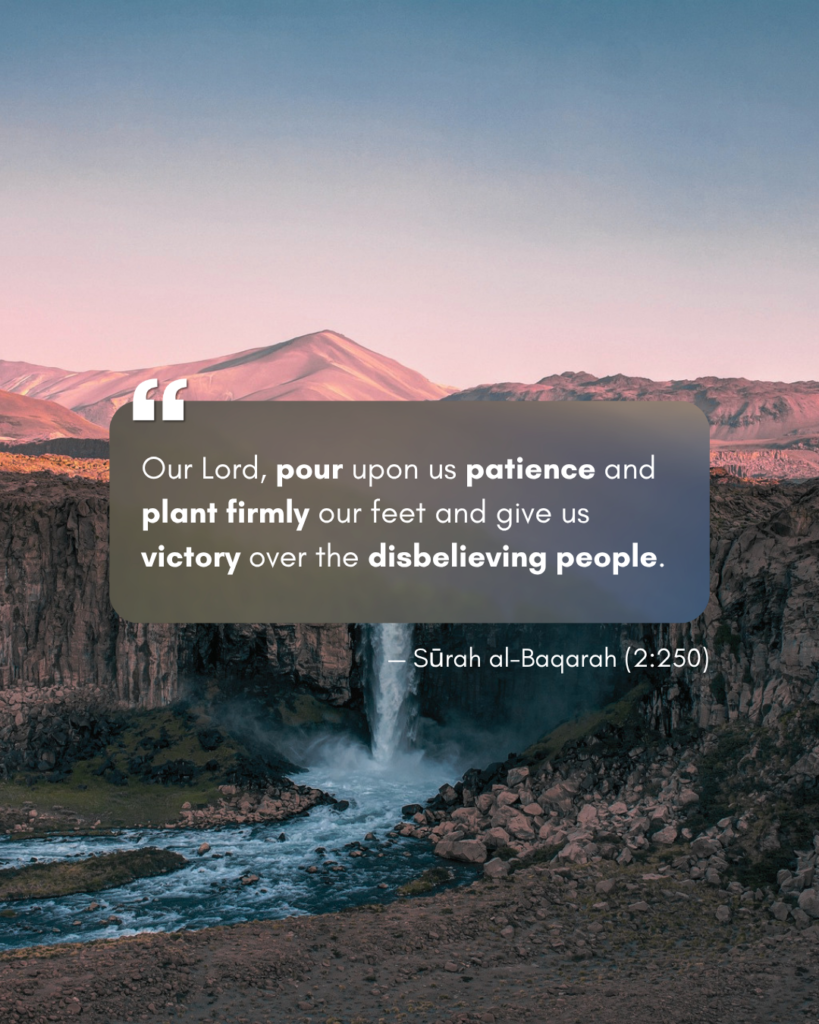
رَبَّنَا أَفْرِغْ عَلَيْنَا صَبْرًا وَثَبِّتْ أَقْدَامَنَا وَانصُرْنَا عَلَى الْقَوْمِ الْكَافِرِينَ
Rabbanā afrigh ʿalaynā ṣabraw-wa thabbit aqdāmanā wanṣurnā ʿalal-qawmil-kāfirīn.
“Our Lord, pour upon us patience and plant firmly our feet and give us victory over the disbelieving people.”
— Sūrah al-Baqarah (2:250)
Three requests, and every one of them is ordered with a precision worth sitting inside.
Rabbanā afrigh ʿalaynā ṣabrā, our Lord, pour upon us patience. Ibn Kathīr raḥimahullāh explains in his commentary on this āyah that this means anzil ʿalaynā, send down patience upon us, and the choice of the verb afrigh (to pour out, to empty completely) rather than a simple iʿṭinā (give us) is deliberate.
A cup is filled gradually. A vessel is poured, all at once, until it overflows. They were not asking for a trickle of endurance sufficient to survive the first clash. They were asking to be flooded with it, because they already understood that a small band facing a large one does not need a little patience rationed carefully across a long day; it needs to be overtaken by it entirely before the first arrow is loosed.
Wa thabbit aqdāmanā, and plant firmly our feet. This request is not for victory, not yet. It is for the far more basic thing that has to happen before victory becomes possible: that their own legs do not carry them backward. This is a request to be saved from al-firār (fleeing) and al-faza’ (panicked collapse), the same failure that had already claimed most of their own people twice, once at the call to fight and once at the river. They had just watched their own companions dissolve under lesser pressure than this. So before they asked to defeat Jālūt, they asked not to become one more example of a people whose feet betrayed their tongues.
Wanṣurnā ʿalal-qawmil-kāfirīn, and give us victory over the disbelieving people. Only third. Only after patience has been requested and firmness has been requested does the request for actual victory appear, and by the time it arrives, it reads almost as a formality, the natural outcome of a heart already flooded with ṣabr and feet already fixed in place.
Fewer Than Ever, and Still Enough
Allāh ʿazza wa jall answers immediately, and in a single verse collapses the entire arc the sūrah has been building since the very first request for a king.
فَهَزَمُوهُم بِإِذْنِ اللَّهِ وَقَتَلَ دَاوُودُ جَالُوتَ وَآتَاهُ اللَّهُ الْمُلْكَ وَالْحِكْمَةَ وَعَلَّمَهُ مِمَّا يَشَاءُ
Fa-hazamūhum bi-idhnillāhi wa qatala Dāwūdu Jālūta wa ātāhul-lāhul-mulka wal-ḥikmata wa ʿallamahū mimmā yashā’.
“So they defeated them by permission of Allāh, and Dāwūd killed Jālūt, and Allāh gave him kingship and wisdom and taught him from that which He willed.”
— Sūrah al-Baqarah (2:251)
Consider who is standing at the center of this victory. Dāwūd ʿalayhissalām is not introduced anywhere earlier in this account as a commander or even as a notable soldier. As Ibn Kathīr raḥimahullāh records in his commentary on this āyah, the widely known account is that he was a young man in Ṭālūt’s ranks, armed with nothing more than a sling, who stepped forward to face the very giant that had made a fully assembled army say lā ṭāqata lanā, we have no power. The remnant that survived the call to fight, survived the river, and stood firm at the sight of Jālūt’s army was narrowed once more, down to a single young man and a single stone.
This is the same pattern Allāh ʿazza wa jall has been repeating from the opening verse of this account: illā qalīlam-minhum, except a few of them, again and again, until what remains is small enough that only Allāh ʿazza wa jall could plausibly be credited with what happens next.
And what happens next reshapes everything. The very kingship Banī Isrā’īl had once denied to Ṭālūt because he lacked wealth and lineage is given, by that same battle, to a shepherd boy who had neither. Allāh ʿazza wa jall grants Dāwūd ʿalayhissalām al-mulk, kingship, al-ḥikmah, prophetic wisdom, and knowledge chosen specifically for him, mimmā yashā’. The people who had insisted that worthiness could be measured in wealth and bloodline watched Allāh ʿazza wa jall hand His greatest gifts to the one candidate their own standard would never have selected.
The Rasūl Who Lived the Same Verse
This exact pattern, a small band, tested and narrowed, standing before an army many times its size, repeats itself again centuries later, and Rasūlullāh ﷺ lived it in a way that mirrors this account almost line for line. On the day of Badr, ʿUmar ibn al-Khaṭṭāb raḍiyallāhu ʿanhu narrated that Rasūlullāh ﷺ looked out at the enemy and saw a thousand men, while his own Companions numbered three hundred and nineteen. He turned to face the qiblah, raised his hands, and cried out.
«اللَّهُمَّ أَنْجِزْ لِي مَا وَعَدْتَنِي، اللَّهُمَّ آتِ مَا وَعَدْتَنِي، اللَّهُمَّ إِنْ تُهْلِكْ هَذِهِ الْعِصَابَةَ مِنْ أَهْلِ الْإِسْلَامِ لَا تُعْبَدْ فِي الْأَرْضِ»
“O Allāh, fulfill for me what You have promised me. O Allāh, bring about what You have promised me. O Allāh, if this small band of Muslims is destroyed, You will not be worshipped on this earth.”
— Ṣaḥīḥ Muslim (1763)
He continued calling out, hands raised, facing the qiblah, until his cloak slipped from his shoulders. Abū Bakr raḍiyallāhu ʿanhu came, replaced it over him, and said, “O Prophet of Allāh, this du’ā of yours to your Lord is sufficient for you. He will surely fulfill what He has promised you.” Rasūlullāh ﷺ was a fi’atun qalīlah, a small company, standing before a fi’atun kathīrah, exactly as this āyah describes, and his own du’ā carries the same movement as the du’ā of the believers before him: an appeal made with total sincerity, before the outcome, not after it, trusting that Allāh ʿazza wa jall’s promise did not require his own numbers to be sufficient.
Allāh ʿazza wa jall answered Rasūlullāh ﷺ as He had answered the small band before him, and the same principle these earlier believers had spoken with their own certainty was proven true again: kam min fi’atin qalīlatin ghalabat fi’atan kathīratan bi-idhnillāh.
The Verse That Closes the Story
The account does not end with Dāwūd’s victory alone. Allāh ʿazza wa jall widens the lens to explain why He allows confrontations like this to occur at all.
وَلَوْلَا دَفْعُ اللَّهِ النَّاسَ بَعْضَهُم بِبَعْضٍ لَّفَسَدَتِ الْأَرْضُ وَلَٰكِنَّ اللَّهَ ذُو فَضْلٍ عَلَى الْعَالَمِينَ
Wa law lā dafʿul-lāhin-nāsa baʿḍahum bi-baʿḍil-lafasadatil-arḍu wa lākinnal-lāha dhū faḍlin ʿalal-ʿālamīn.
“And if Allāh did not check some people by means of others, the earth would be corrupted, but Allāh is full of bounty to the worlds.”
— Sūrah al-Baqarah (2:251)
Ibn Kathīr raḥimahullāh connects this directly, in his commentary on this āyah, to a similar warning in Sūrah al-Ḥajj, that without this Divine check, monasteries, churches, synagogues, and masājid where Allāh’s Name is mentioned often would all be torn down. The small band who stood at the river and refused to drink, and the smaller band still who stood their ground before Jālūt, were not merely fighting for their own survival. They were, without fully knowing it, the very means by which Allāh ʿazza wa jall preserved a portion of the earth from ruin. This is the closing note of the account.
تِلْكَ آيَاتُ اللَّهِ نَتْلُوهَا عَلَيْكَ بِالْحَقِّ وَإِنَّكَ لَمِنَ الْمُرْسَلِينَ
Tilka āyātul-lāhi natlūhā ʿalayka bil-ḥaqqi wa innaka la-minal-mursalīn.
“These are the verses of Allāh which We recite to you in truth. And indeed, you are among the messengers.”
— Sūrah al-Baqarah (2:252)
The very last line of the account turns from Banī Isrā’īl, from Ṭālūt, from Dāwūd, and lands directly on Rasūlullāh ﷺ himself, as though Allāh ʿazza wa jall is telling him plainly: this story was always for you too. Every remnant, every narrowing, every qalīlam-minhum across this passage was leading toward a confirmation of his own prophethood, delivered in the same breath as the account of a small band who trusted Him against impossible numbers, centuries before he stood at Badr and did the very same thing.
And What About Us?
This section is a reminder to my brothers and sisters in Islam who are reading, but first to myself.
Rasūlullāh ﷺ did not leave us to wonder whether Banī Isrā’īl’s story was only history. He told us plainly that it would not stay in the past.
«لَتَتَّبِعُنَّ سَنَنَ الَّذِينَ مِنْ قَبْلِكُمْ شِبْرًا بِشِبْرٍ وَذِرَاعًا بِذِرَاعٍ، حَتَّى لَوْ دَخَلُوا جُحْرَ ضَبٍّ لَاتَّبَعْتُمُوهُمْ، قُلْنَا: يَا رَسُولَ اللَّهِ، الْيَهُودَ وَالنَّصَارَى؟ قَالَ: فَمَنْ؟»
“You will follow the ways of those who came before you, span by span, cubit by cubit, until if they entered a lizard’s hole, you would follow them in.” We said, “O Messenger of Allāh, the Jews and the Christians?” He said, “Who else?”
— Ṣaḥīḥ al-Bukhārī (7320), Ṣaḥīḥ Muslim (2669)
This is the majority at the river again, only now it is us standing at its edge. We have already met this crowd once in this article: fa-sharibū minhu illā qalīlam-minhum, they drank from it, except a few of them. Rasūlullāh ﷺ is telling us plainly that this Ummah will be tested at the very same river, will be handed the very same excuses, and that most of us, span by span, cubit by cubit, will drink exactly as Banī Isrā’īl drank, telling ourselves the whole way down that this mouthful surely does not count.
Look at what their drinking actually looked like before you look for ours. Allāh ʿazza wa jall describes it plainly:
اتَّخَذُوا أَحْبَارَهُمْ وَرُهْبَانَهُمْ أَرْبَابًا مِّن دُونِ اللَّهِ
Ittakhadhū aḥbārahum wa ruhbānahum arbābam-min dūnillāh.
“They have taken their rabbis and monks as lords besides Allāh.”
— Sūrah at-Tawbah (9:31)
Not by bowing to them. By following them into calling ḥalāl what Allāh ʿazza wa jall had forbidden and ḥarām what He had permitted, and calling that following “religion.” This is the actual mechanism of the lizard’s hole. It does not announce itself as disbelief. It announces itself as “this is normal now,” the same quiet permission that let a whole army drink at a riverbank without a single one of them feeling like they had failed a test.
We are standing at that same river today, and the water has simply been renamed. Rasūlullāh ﷺ warned us of this exact renaming:
«لَيُشْرِبَنَّ نَاسٌ مِنْ أُمَّتِي الْخَمْرَ يُسَمُّونَهَا بِغَيْرِ اسْمِهَا»
“There will certainly be people from my Ummah who will drink wine, calling it by another name.”
— Sunan Ibn Mājah (4020)
Renaming what is ḥarām does not change what it is before Allāh ʿazza wa jall. It only changes how comfortable we feel drinking it, which is precisely how a people slide, generation by generation, from disobedience they know is disobedience into disobedience they have trained themselves not to notice at all.
And there is a second river Rasūlullāh ﷺ warned us of, one that needs no renaming at all because it comes dressed as blessing rather than sin:
«فَوَاللَّهِ لَا الْفَقْرَ أَخْشَى عَلَيْكُمْ، وَلَكِنِّي أَخْشَى أَنْ تُبْسَطَ الدُّنْيَا عَلَيْكُمْ كَمَا بُسِطَتْ عَلَى مَنْ كَانَ قَبْلَكُمْ، فَتَنَافَسُوهَا كَمَا تَنَافَسُوهَا، وَتُهْلِكَكُمْ كَمَا أَهْلَكَتْهُمْ»
“By Allāh, it is not poverty that I fear for you, but I fear that the world will be opened up for you as it was opened up for those before you, and you will compete for it as they competed for it, and it will destroy you as it destroyed them.”
— Ṣaḥīḥ al-Bukhārī (3158), Ṣaḥīḥ Muslim (2961)
Banī Isrā’īl did not fall at Jālūt first. They fell at a river, quietly, with no enemy watching, telling themselves a single mouthful could not possibly matter. Wal-ʿiyādhu billāh, look around at how casually the same mouthfuls are taken today, and ask honestly whether we are still standing on the bank, or whether we are already, span by span, inside the water ourselves.
So before asking Allāh ʿazza wa jall to make us of the few, the question has to be asked honestly first: have we already, in small and unnoticed ways, joined the many? Where have we called something ḥalāl because it was easier than calling it what it is? Where has a ḥarām become background noise in our own homes, simply because refusing it felt like more resistance than we wanted to spend? Recognizing this hadith when we read it is not the same as resisting the river it describes.
Rasūlullāh ﷺ did not warn us so that we could nod along and then return to drink from it anyway. He warned us so that we would be counted among the qalīlam-minhum, the few who refused, rather than the many who will later say, with complete sincerity, that they never even noticed the water reaching their mouths.
We ask Allāh ʿazza wa jall by His Names to never make us of those who followed Banī Isrā’īl into their own destruction, span by span, cubit by cubit, into whatever hole they entered. May He guide us instead onto aṣ-Ṣirāṭ al-Mustaqīm, and keep our feet from ever wandering toward the mouth of that hole in the first place.
Yā Rabb, pour upon us ṣabr as You poured it upon the believers who stood at the river, not a measured portion but an overflowing one, sufficient for whatever test meets us before we ever see it coming.
Yā Rabb, plant firmly our feet where our own companions have fled, and let us not be counted among those who promise firmness in ease and discover their own weakness the moment ease is taken from them.
Yā Rabb, let our conviction rest on the certainty that we will meet You, not on the certainty of any outcome we can see, so that our firmness does not depend on the odds ever being in our favor.
Yā Rabb, do not let us be the majority who drank from the river while calling ourselves believers. Let us be counted, however few we are, among those who held back.
Yā Rabb, do not let us be of those who followed the nations before us span by span until we no longer recognized the hole we had entered. Keep our tongues from calling Your ḥalāl ḥarām and Your ḥarām ḥalāl, in ease or in hardship, in private or before people.
Yā Rabb, give us victory over what stands between us and You, whether it wears the face of an army or the much smaller face of our own excuses, our own delay, our own thirst for what was never ours to take.
Yā Rabb, You are the One who checks some by means of others, and preserves what remains good on this earth through those who are willing to stand where standing is hard. Let us be counted among the means, not among the reasons the earth needed checking.
Āmīn yā Rabb al-ʿĀlamīn, bi-raḥmatika yā Arḥam ar-Rāḥimīn.