﷽
Before there was an army that marched for revenge, before there was a rumor that broke an army’s knees, before there was a hill that decided a battle, and before the du’ā of the ribbiyyūn, there was a promise: men positioned on high ground, told that no matter what they saw happen below them, they were not to move.
The Dream That Sealed the March
A year after Badr, the night before the Quraysh marched on Madīnah with three thousand men, determined to answer their defeat, Rasūlullāh ﷺ had seen a dream that told him something of what was coming. He ﷺ told the Companions:
“I dreamt that I was about to migrate from Mecca to a land abounding in palm trees and I guessed that it would be Yamama or Hajar, but it was the city of Yathrib. And I saw in this dream that I was brandishing a sword and its upper end was broken – and this is what fell (in the form of misfortune to the believers on the Day of Uhud). I brandished it for the second time and it became all right – and this is what came to be true when Allah granted us victory and solidarity of the believers. And I saw cows in my dream, and by Allah, that was a blessing, and they symbolized the believers on the Day of Uhud.”
— Ṣaḥīḥ Muslim (2272)
He ﷺ interpreted the broken sword as the casualties the believers would suffer, and the cows as the believers themselves on the Day of Uhud. He ﷺ also interpreted another dream he saw of a strong coat of mail as meaning that it was better for them to remain in Madīnah and defend from within. As Jābir ibn ʿAbdillāh raḍiyallāhu ʿanhu narrated:
‘The Messenger of Allāh ﷺ said: “I saw as if I was in a strong coat of mail, and I saw cows being slaughtered. So I interpreted the coat of mail as Madīnah, and the cows—by Allāh—as good.”‘
— Narrated by Jābir ibn ʿAbdillāh raḍiyallāhu ʿanhu in Musnad Aḥmad (no. 14787) and Sunan al-Nasāʾī al-Kubrā (no. 7647), graded ṣaḥīḥ by al-Albānī in Ṣaḥīḥ al-Jāmiʿ (no. 3476)
Rasūlullāh ﷺ preferred this plan. He wanted to stay inside the city, let the enemy exhaust themselves, and fight them at the narrow passages. Some of the prominent Companions agreed with him ﷺ.
But a group of young men who had missed the Battle of Badr, burning with zeal and the desire for martyrdom, insisted forcefully that they should go out and meet the enemy. They feared the Quraysh would think them cowards. One of them said:
“O, Messenger of Allah (Peace be upon him), for long time we have been looking forward to this day; and we have implored Allah to make such a day draw near. Thanks to Allah it is time to fight. So let us go out and fight our enemies lest they should think that we have lost heart and do not dare to fight them.”
Ḥamzah ibn ʿAbd al-Muṭṭalib raḍiyallāhu ʿanhu, the paternal uncle of Rasūlullāh ﷺ, was ahead of those who urged him to go out. He said to Rasūlullāh ﷺ:
“By Allah, Who has sent the Book down unto you, I will not taste food till I fight them with my sword outside Madinah.”
After weighing the matter carefully, the decision was made to resist the enemy outside the city at Uḥud.
Rasūlullāh ﷺ led the afternoon prayer with the people, then entered his house accompanied by Abū Bakr and ʿUmar raḍiyallāhu ʿanhumā. They helped him ﷺ dress and put on his armor. When he ﷺ came out, regret struck those who had insisted. They realized they had pressured the Rasūlullāh ﷺ against his own judgment. Saʿd ibn Muʿādh and Usayd ibn Ḥuḍayr raḍiyallāhu ʿanhumā blamed the people and said:
“You have forced the Messenger of Allah (Peace be upon him) to fight the enemy outside Madinah.”
When Rasūlullāh ﷺ came out, they said:
“O Messenger of Allah, we should have not disagreed with you. So, you are free to do what you desire. If you prefer to stay inside Madinah we will stay with you.”
Upon this, Rasūlullāh ﷺ gave them the answer that sealed the decision:
“It does not become a Prophet that once he had put on armour, he should take it off, until Allah has decided between him and the enemy.”
All quotes above from The Sealed Nectar (Ar-Raheeq Al-Makhtum), page 157
The armor was a commitment. The decision was made. And so, the army marched.
The Army That Marched Out for Revenge
The Quraysh finally marched on Madīnah with three thousand men. Rasūlullāh ﷺ went out to meet them at the foot of Mount Uḥud with a force of only a thousand, and even that small number was cut further when the hypocrite ʿAbdullāh ibn Ubayy withdrew with three hundred of his men on the way, leaving seven hundred to face an army more than four times their size.
Before the lines met, Rasūlullāh ﷺ took a precise and deliberate precaution in consideration of the dream he ﷺ saw. Al-Barā’ ibn ʿĀzib raḍiyallāhu ʿanhu, who stood among those very ranks that day, narrated exactly what was said:
«فَلَمَّا لَقِينَاهُمُ انْهَزَمُوا، حَتَّى رَأَيْتُ النِّسَاءَ يَشْتَدِدْنَ فِي الجَبَلِ، رَفَعْنَ عَنْ سُوقِهِنَّ قَدْ بَدَتْ خَلاَخِلُهُنَّ، فَأَخَذُوا يَقُولُونَ الغَنِيمَةَ الغَنِيمَةَ، فَقَالَ عَبْدُ اللَّهِ بْنُ جُبَيْرٍ: عَهِدَ إِلَيَّ النَّبِيُّ صَلَّى اللهُ عَلَيْهِ وَسَلَّمَ أَنْ لاَ تَبْرَحُوا»
“When we met them, they fled, until I saw their women running up the mountain, lifting up their clothes so that their leg-bangles were showing. The men started saying, ‘The booty, the booty!’ ʿAbdullāh ibn Jubayr said, ‘Rasūlullāh ﷺ took a firm promise from me not to leave this place.'”
— Ṣaḥīḥ al-Bukhārī (4043)
Rasūlullāh ﷺ had stationed fifty archers under ʿAbdullāh ibn Jubayr raḍiyallāhu ʿanhu on a small rise overlooking the Muslim flank, and gave them an instruction that left no room for interpretation:
«لاَ تَبْرَحُوا مَكَانَكُمْ إِنْ رَأَيْتُمُونَا ظَهَرْنَا عَلَيْهِمْ فَلاَ تَبْرَحُوا، وَإِنْ رَأَيْتُمُوهُمْ ظَهَرُوا عَلَيْنَا فَلاَ تُعِينُونَا»
“Do not leave this place. If you should see us conquering the enemy, do not leave this place, and if you should see them conquering us, do not come to help us.”
— Ṣaḥīḥ al-Bukhārī (4043)
According to al-Barā’ raḍiyallāhu ʿanhu, the instruction in a form still repeated in seerah gatherings today, that even if they saw birds snatching the army away from the field below, they were not to leave that hill.
The battle opened in the Muslims’ favour. The Quraysh lines broke, their camp lay open, and it seemed the day was already decided. And it was at exactly this moment, watching the enemy in retreat and the spoils apparently there for the taking, that most of the archers left their post. A remnant stayed, led by Ibn Jubayr raḍiyallāhu ʿanhu himself, insisting the Prophet’s ﷺ order had not been lifted. They were not enough to hold the hill alone. Khālid ibn al-Walīd, still fighting for the Quraysh at that point in his life, saw the flank now standing open and rode his cavalry straight through it, folding around the Muslim lines from behind.
The battle that had already been won was thrown into chaos within minutes. In that confusion, the worst was yet to unfold: Rasūlullāh ﷺ was struck and wounded. His blessed face was gashed, his lower incisor broken, and two rings of his helmet driven into his cheek. And Ḥamzah ibn ʿAbd al-Muṭṭalib raḍiyallāhu ʿanhu, the Lion of Allāh, had fallen.
The Fall of the Lion
The chaos of the battle had taken its toll. But in the midst of that devastation, not all responded the same way.
According to The Sealed Nectar, in the chapter “Assassination of Asadullah (the Lion of Allah) Ḥamzah bin ‘Abdul Muttalib”, as the dust settled and the Muslims looked around them, they found seventy of their brothers lying still on the battlefield. Among them was Ḥamzah ibn ‘Abd al-Muttalib raḍiyallāhu ʿanhu, the paternal uncle of Rasūlullāh ﷺ, Asadullah (the Lion of Allah) and the Lion of His Messenger.
At Badr, Ḥamzah raḍiyallāhu ʿanhu had killed ‘Utbah ibn Rabi’ah in single combat. ‘Utbah was the father of Hind bint ‘Utbah, the wife of Abu Sufyan, and his death at the hands of Hamzah raḍiyallāhu ʿanhu ignited a burning desire for vengeance in her heart.
It was Waḥshī ibn Ḥarb, an Abyssinian slave renowned for his deadly accuracy with the spear, who was promised his freedom by his master, Jubayr ibn Muṭ’im, if he could kill Ḥamzah raḍiyallāhu ʿanhu. Jubayr sought revenge for his uncle Ṭu’aymah ibn ‘Adī, who had been killed at Badr. Waḥshī, a skilled hunter, weighed his options. He knew he could not get close to Muḥammad ﷺ or ‘Alī raḍiyallāhu ʿanhu, as they were heavily guarded and vigilant. Ḥamzah raḍiyallāhu ʿanhu, however, was a fierce and furious warrior who paid little attention to his flanks when engaged in battle, making him vulnerable to a surprise attack.
On the battlefield of Uhud, Waḥshī lay in wait for Ḥamzah raḍiyallāhu ʿanhu. As the great warrior fought fiercely, cutting down the enemy, Waḥshī saw his chance. He later described what happened:
“Then I balanced my spear and shook it till I was content with it, then I speared him and it went down into his stomach and issued out between his legs. He attempted moving towards me but he was overcome by his wound. I left him there with the spear in his entrails till he died. Then I came to him, pulled out my spear and returned to the encampment place. I stayed there and did not go out, for he was the only one I sought. I only killed him to free myself. So as soon as I got back to Makkah, I became a free man.”
When Rasūlullāh ﷺ came upon the body of his uncle, he saw a sight that broke his heart. According to The Sealed Nectar, in the chapter “Mutilation of the Martyrs”, the idolaters had mutilated Ḥamzah’s body in the most brutal fashion. Women and men cut off the ears, the noses, and the genitals of the martyrs. They even cut open their bellies. Hind bint ‘Utbah, driven by her consuming vengeance, ripped open the liver of Ḥamzah and chewed it; and then she spat it out. She even made the ears and noses of Muslims into anklets and necklaces.
A Rumor That Broke Ranks
And it was out of that very chaos, with the dust thick enough that men could no longer see clearly who stood where, that the worst rumor of the day began to spread.
Shayṭān shouted across the battlefield that Rasūlullāh ﷺ had been killed. As Ibn Kathīr raḥimahullāh records in his commentary on Sūrah Āl-ʿImrān (3:144), Ibn Qamiʾah returned to the idolaters boasting, “I have killed Muḥammad.” Some of the Muslims believed it. Their resolve broke, and they stood frozen on the battlefield, reasoning that surely a Prophet could not be killed, though Allāh ʿazza wa jall had already told them this had happened to Prophets before them.
It was in the middle of this exact confusion that Allāh ʿazza wa jall revealed the verse that reframes the entire tragedy.
وَمَا مُحَمَّدٌ إِلَّا رَسُولٌ قَدْ خَلَتْ مِن قَبْلِهِ الرُّسُلُ ۚ أَفَإِن مَّاتَ أَوْ قُتِلَ انقَلَبْتُمْ عَلَىٰ أَعْقَابِكُمْ ۚ وَمَن يَنقَلِبْ عَلَىٰ عَقِبَيْهِ فَلَن يَضُرَّ اللَّهَ شَيْئًا ۗ وَسَيَجْزِي اللَّهُ الشَّاكِرِينَ
Wa mā Muḥammadun illā rasūlun qad khalat min qablihir-rusul. Afa’im-māta aw qutila inqalabtum ʿalā aʿqābikum. Wa may-yanqalib ʿalā ʿaqibayhi fa-lay-yaḍurral-lāha shay’ā, wa sayajzil-lāhush-shākirīn.
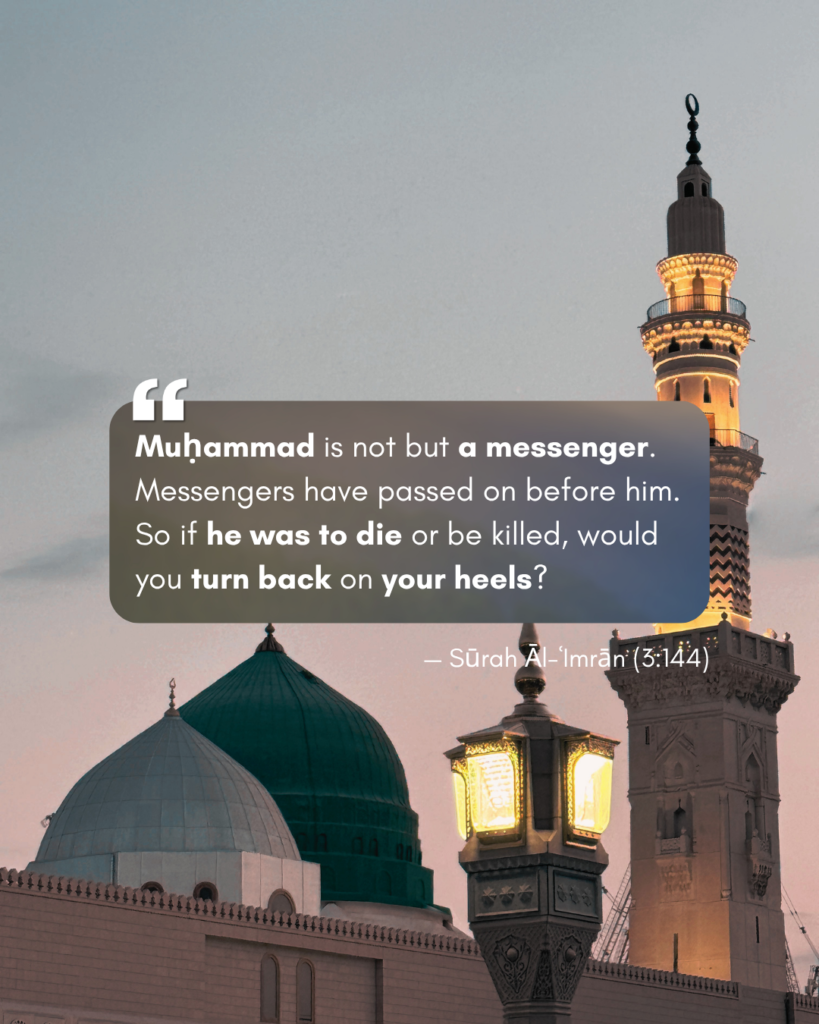
“Muḥammad is not but a messenger. Messengers have passed on before him. So if he was to die or be killed, would you turn back on your heels? And he who turns back on his heels will never harm Allāh at all. And Allāh will reward the grateful.”
— Sūrah Āl-ʿImrān (3:144)
Ibn Kathīr raḥimahullāh notes in his commentary on this āyah that a man from the Muhājirīn passed a bleeding Anṣārī on that battlefield and asked him, “Did you know that Muḥammad ﷺ was killed?” The Anṣārī’s answer became one of the great single lines of the entire day: “Even if Muḥammad ﷺ was killed, he has indeed conveyed the Message. Therefore, defend your religion.” He did not lower his weapon. He did not sit down in grief. He understood, in the middle of a battlefield, what some full-grown believers had not: that their loyalty had never been to a man’s continued presence, but to a Message that man had already delivered.
The Wisdom Behind the Loss
Grief and confusion filled everyone’s hearts. They had tasted victory at Badr, where they had inflicted twice the casualties on the Quraysh. Now they had suffered a devastating loss, and the question weighed heavily on them: How could this be?
Allāh ʿazza wa jall answered them directly:
أَوَلَمَّا أَصَابَتْكُم مُّصِيبَةٌ قَدْ أَصَبْتُم مِّثْلَيْهَا قُلْتُمْ أَنَّىٰ هَٰذَا ۖ قُلْ هُوَ مِنْ عِندِ أَنفُسِكُمْ ۗ إِنَّ اللَّهَ عَلَىٰ كُلِّ شَيْءٍ قَدِيرٌ
Awa lammā aṣābatkum muṣībatun qad aṣabtum mithlayhā qultum annā hādhā? Qul huwa min ʿindi anfusikum. Inna Allāha ʿalā kulli shay’in qadīr.
“Why [is it that] when a [single] disaster struck you [on the day of Uḥud], although you had struck [the enemy in the battle of Badr] with one twice as great, you said, “From where is this?” Say, “It is from yourselves [i.e., due to your sin].” Indeed, Allāh is over all things competent.”
— Sūrah Āl-ʿImrān (3:165)
The answer was direct and unflinching: huwa min ʿindi anfusikum, it is from yourselves. The archers who had abandoned their post, the disobedience that had opened the flank, the pursuit of spoils over obedience: all of it had consequences. And yet, in the very same breath, Allāh ʿazza wa jall reminded them of His power: inna Allāha ʿalā kulli shay’in qadīr. The loss was not because He was weak. It was because they had been tested and found wanting.
And then Allāh ʿazza wa jall revealed the deeper purpose behind the trial:
وَلَقَدْ نَصَرَكُمُ اللَّهُ بِبَدْرٍ وَأَنتُمْ أَذِلَّةٌ ۖ فَاتَّقُوا اللَّهَ لَعَلَّكُمْ تَشْكُرُونَ
“And already had Allah given you victory at Badr while you were few in number. So fear Allah, perhaps you will be grateful.”
— Sūrah Āl-ʿImrān (3:123)
The victory at Badr had come when they were weak and outnumbered. The loss at Uḥud had come when they were stronger and had disobeyed. The pattern was clear: victory was never about numbers. It was about obedience.
Allāh ʿazza wa jall then explained the wisdom of what had happened:
وَمَا أَصَابَكُمْ يَوْمَ الْتَقَى الْجَمْعَانِ فَبِإِذْنِ اللَّهِ وَلِيَعْلَمَ الْمُؤْمِنِينَ
Wa mā aṣābakum yawma l-taqā l-jamʿāni fa-bi-idhnil-lāhi wa li-yaʿlama l-mu’minīn.
“So what you suffered on the day the two armies met was by Allah’s Will, so that He might distinguish the (true) believers.”
— Sūrah Āl-ʿImrān (3:166)
Li-yaʿlama l-mu’minīn: so that He might distinguish the believers. The test was not random. It was a sieve. It was meant to separate those whose faith was real from those whose faith was only words. The ones who stood firm despite the chaos, despite the rumor, despite the loss: their faith was genuine. The ones who froze, who retreated, who questioned: their faith was exposed.
And the same test exposed the hypocrites among them:
وَلِيَعْلَمَ الَّذِينَ نَافَقُوا ۚ وَقِيلَ لَهُمْ تَعَالَوْا قَاتِلُوا فِي سَبِيلِ اللَّهِ أَوِ ادْفَعُوا ۖ قَالُوا لَوْ نَعْلَمُ قِتَالًا لَّاتَّبَعْنَاكُمْ ۗ هُمْ لِلْكُفْرِ يَوْمَئِذٍ أَقْرَبُ مِنْهُمْ لِلْإِيمَانِ ۚ يَقُولُونَ بِأَفْوَاهِهِم مَّا لَيْسَ فِي قُلُوبِهِمْ ۗ وَاللَّهُ أَعْلَمُ بِمَا يَكْتُمُونَ
Wa li-yaʿlama lladhīna nāfaqū. Wa qīla lahum taʿālaw qātilū fī sabīlil-lāhi awi dfaʿū. Qālū law naʿlamu qitālan lattabaʿnākum. Hum lil-kufri yawma’idhin aqrabu minhum lil-īmān. Yaqūlūna bi-afwāhihim mā laysa fī qulūbihim, wallāhu aʿlamu bimā yaktumūn.
“And so that He might expose the hypocrites. When it was said to them, ‘Come fight in the cause of Allah or (at least) defend yourselves,’ they replied, ‘If we had known there was fighting, we would have definitely gone with you.’ They were closer to disbelief than to belief on that day — for saying with their mouths what was not in their hearts. Allah is All-Knowing of what they hide.”
— Sūrah Āl-ʿImrān (3:167)
Notice the contrast. The true believers, the ribbiyyūn, said: rabbanaghfir lanā dhunūbanā wa isrāfanā fī amrinā: our Lord, forgive us our sins and our transgressions in our affair. They looked inward. They confessed their own shortcomings. They asked for forgiveness before they asked for victory.
The hypocrites, on the other hand, made excuses. Law naʿlamu qitālan lattabaʿnākum: if we had known there was fighting, we would have followed you. They claimed they would have fought if only they had known. But the battle was already before them. The fight was already happening. Their words were hollow, and Allāh ʿazza wa jall exposed them: hum lil-kufri yawma’idhin aqrabu minhum lil-īmān: they were closer to disbelief than to belief on that day.
This is the wisdom of the test. The battle was not just about victory or defeat. It was about revealing what was in the hearts. It distinguished the obedient from the disobedient. It exposed the sincere from the hypocrites. And it taught the believers, then and now, that the battlefield is not only outside. It is within.
The ones who suffered, the ones who were wounded, the ones who fell: they were not abandoned. They were promised mercy. The test was a purification, not a punishment. And the believers who stood firm, who confessed their sins, who asked for forgiveness before they asked for victory: they were the ones who emerged from the test with their faith intact.
A Verse Nobody Had Truly Heard
Here is the detail worth sitting inside before moving forward, because this same āyah was about to have a second, far heavier moment years later, and the strangest part of that second moment is that almost nobody in the room recognized it.
When Rasūlullāh ﷺ actually did pass away, ʿUmar raḍiyallāhu ʿanhu stood before the people in a state of overwhelming grief and denial, declaring, “By Allāh, Rasūlullāh ﷺ is not dead.” Abū Bakr raḍiyallāhu ʿanhu, who had been at his home in as-Sunḥ, mounted his horse and rode in. He entered upon ʿĀ’ishah raḍiyallāhu ʿanhā without speaking to anyone, went to Rasūlullāh ﷺ, who lay covered with a cloth, uncovered his face, bent over him, kissed him, and wept, saying,
“Let my father and mother be sacrificed for you. By Allāh, Allāh will never make you taste death twice. As for the death that was written for you, it has come upon you.”
— Ṣaḥīḥ al-Bukhārī (4452), also recorded in Ṣaḥīḥ al-Bukhārī (3667)
Abū Bakr raḍiyallāhu ʿanhu then went outside, where ʿUmar raḍiyallāhu ʿanhu was still speaking, still refusing to accept it. Abū Bakr raḍiyallāhu ʿanhu told him to sit, and when ʿUmar raḍiyallāhu ʿanhu refused, the people gathered around Abū Bakr raḍiyallāhu ʿanhu instead and left ʿUmar raḍiyallāhu ʿanhu standing alone. Abū Bakr raḍiyallāhu ʿanhu addressed them directly.
“Whoever among you used to worship Muḥammad, then Muḥammad is dead. But whoever worships Allāh, then Allāh is alive and does not die.”
He then recited wa mā Muḥammadun illā rasūlun qad khalat min qablihir-rusul, the very same āyah revealed years earlier on the battlefield of Uḥud, at the exact moment the Ṣaḥābah needed to hear it the first time.
— Ṣaḥīḥ al-Bukhārī (4452), Ṣaḥīḥ al-Bukhārī (1241)
ʿĀ’ishah raḍiyallāhu ʿanhā, narrating this scene, added something remarkable.
«فَوَاللَّهِ لَكَأَنَّ النَّاسَ لَمْ يَكُونُوا يَعْلَمُونَ أَنَّ اللَّهَ أَنْزَلَ هَذِهِ الآيَةَ حَتَّى تَلاَهَا أَبُو بَكْرٍ»
“By Allāh, it was as if the people had never known that Allāh had revealed this verse before, until Abū Bakr recited it.”
— Ṣaḥīḥ al-Bukhārī (1241), Ṣaḥīḥ al-Bukhārī (4452)
An āyah that had already been revealed once, publicly, on the very battlefield where Rasūlullāh ﷺ was rumored dead, was heard by an entire generation of Ṣaḥābah as though for the first time, decades later, at the moment its meaning finally became unbearable and necessary in equal measure. And ʿUmar raḍiyallāhu ʿanhu himself, the very man who had stood moments earlier insisting Rasūlullāh ﷺ could not have died, later described what that recitation did to him.
«وَاللَّهِ لَكَأَنِّي لَمْ أَقْرَأِ الآيَةَ حَتَّى سَمِعْتُ أَبَا بَكْرٍ يَتْلُوهَا»
“By Allāh, it was as if I had never recited this āyah before, until I heard Abū Bakr recite it.”
— narrated by Saʿīd ibn al-Musayyib raḥimahullāh, in Ṣaḥīḥ al-Bukhārī (4452)
His legs gave out beneath him, and he fell to the ground on the spot. This is worth sitting with fully. ʿUmar raḍiyallāhu ʿanhu was not a man unfamiliar with the Qurʾān. He had almost certainly heard this āyah recited before, perhaps even on the day it was revealed at Uḥud itself. And yet the meaning of it had never actually reached him until the moment he needed it to be true rather than merely correct. The very verse revealed to steady an army confused by a rumor became, years later, the verse that steadied an Ummah facing the reality itself, and it took the death of Rasūlullāh ﷺ for even a man like ʿUmar raḍiyallāhu ʿanhu to finally hear what he had already been told. Tawḥīd does not shift depending on whether the news is false or true. The Message outlives the Messenger either way, and it was always meant to.
No Coward Escapes His Term
Allāh ʿazza wa jall then addresses the deeper fear underneath the panic at Uḥud: the fear that standing firm in battle might cost a person his life sooner than sitting it out would.
وَمَا كَانَ لِنَفْسٍ أَن تَمُوتَ إِلَّا بِإِذْنِ اللَّهِ كِتَابًا مُّؤَجَّلًا
Wa mā kāna li-nafsin an tamūta illā bi-idhnil-lāhi kitābam-mu’ajjalā.
“And it is not for a soul to die except by Allāh’s permission, at a decree determined.”
— Sūrah Āl-ʿImrān (3:145)
Ibn Kathīr raḥimahullāh explains in his commentary on this āyah that no one dies except by Allāh’s decision, once the term already destined for him has come to its end. Neither courage nor cowardice moves that appointed term forward or backward by so much as a moment. He records that Ḥujr ibn ʿAdī, standing before a river his army was afraid to cross toward the enemy, recited this very āyah and rode his horse across alone. The rest of the army followed him, and the enemy, seeing them come, fled shouting that they were mad.
There is nothing reckless in that crossing. It is the most rational act available to a man who has actually internalized kitābam-mu’ajjalā, a decree already fixed. Fear of death cannot move a term that Allāh ʿazza wa jall has already sealed.
The Company That Did Not Weaken
Allāh ʿazza wa jall then turns to comfort the believers with the example of those who came before them, companions of earlier Prophets who buried their own Prophets and still did not waver.
وَكَأَيِّن مِّن نَّبِيٍّ قَاتَلَ مَعَهُ رِبِّيُّونَ كَثِيرٌ فَمَا وَهَنُوا لِمَا أَصَابَهُمْ فِي سَبِيلِ اللَّهِ وَمَا ضَعُفُوا وَمَا اسْتَكَانُوا ۗ وَاللَّهُ يُحِبُّ الصَّابِرِينَ
Wa ka’ayyim-min nabiyyin qātala maʿahū ribbiyyūna kathīr, famā wahanū limā aṣābahum fī sabīlil-lāhi wa mā ḍaʿufū wa mastakānū, wallāhu yuḥibbuṣ-ṣābirīn.
“And how many a Prophet fought, [and] with him fought many Ribbiyyūn. They neither lost heart for what afflicted them in the cause of Allāh, nor did they weaken nor humble themselves. And Allāh loves the steadfast.”
— Sūrah Āl-ʿImrān (3:146)
Ibn ʿAbbās raḍiyallāhu ʿanhu, along with several other early commentators including Mujāhid raḥimahullāh and Qatādah raḥimahullāh, explained ribbiyyūn as large, faithful bands of believers. Ibn Kathīr raḥimahullāh records in his commentary on this āyah that they neither weakened after their Prophet was killed, as Qatādah raḥimahullāh and ar-Rabīʿ ibn Anas raḥimahullāh noted, nor gave in to the enemy, as as-Suddī raḥimahullāh and Ibn Zayd raḥimahullāh explained. They continued fighting on the very path their Prophet had walked until they met Allāh ʿazza wa jall themselves.
And here is what these ribbiyyūn actually said while they carried that grief and kept fighting anyway.
The Du’ā
وَمَا كَانَ قَوْلَهُمْ إِلَّا أَن قَالُوا رَبَّنَا اغْفِرْ لَنَا ذُنُوبَنَا وَإِسْرَافَنَا فِي أَمْرِنَا وَثَبِّتْ أَقْدَامَنَا وَانصُرْنَا عَلَى الْقَوْمِ الْكَافِرِينَ
Wa mā kāna qawlahum illā an qālū Rabbanaghfir lanā dhunūbanā wa isrāfanā fī amrinā wa thabbit aqdāmanā wanṣurnā ʿalal-qawmil-kāfirīn.
“And their words were not but that they said, ‘Our Lord, forgive us our sins and our transgressions in our affair, and make our feet firm and give us victory over the disbelieving people.'”
— Sūrah Āl-ʿImrān (3:147)
Notice what comes first. Not a plea for safety. Not even the plea for victory that closes the āyah. They open with dhunūbanā wa isrāfanā fī amrinā, and these are two distinct things, not one. Dhunūb are the sins themselves, the direct transgressions against Allāh ʿazza wa jall. Isrāf is going beyond the limit, excess in one’s own affairs, the heedlessness and carelessness that is not always willful sin but is its close companion. They asked forgiveness for both: the outright wrong and the excess that surrounded it. Standing on a battlefield, in the middle of loss, facing an enemy in front of them, the first thing on their tongues was not the enemy at all. It was the full inventory of their own shortcomings before Allāh ʿazza wa jall.
This is the same instinct that runs through the du’ā of the people of understanding earlier in this very sūrah, who feared the Fire before they ever asked for Paradise: the believer’s own sin is the first battlefield, before any other.
Only after that confession do they ask for thabbit aqdāmanā, make our feet firm. Not victory first. Firmness first. A person can be granted victory and still collapse under it if his feet were never made steady to begin with. And then, only then, wanṣurnā ʿalal-qawmil-kāfirīn, give us victory over the disbelieving people. Forgiveness, then firmness, then victory: an order that refuses to let the battle against the enemy outside come before the battle against the self within.
The Reward That Followed
Allāh ʿazza wa jall tells us plainly what this du’ā earned them.
فَآتَاهُمُ اللَّهُ ثَوَابَ الدُّنْيَا وَحُسْنَ ثَوَابِ الْآخِرَةِ ۗ وَاللَّهُ يُحِبُّ الْمُحْسِنِينَ
Fa’ātāhumul-lāhu thawābad-dunyā wa ḥusna thawābil-ākhirah, wallāhu yuḥibbul-muḥsinīn.
“So Allāh gave them the reward of this world and the excellent reward of the Hereafter. And Allāh loves the doers of good.”
— Sūrah Āl-ʿImrān (3:148)
Ibn Kathīr raḥimahullāh explains in his commentary on this āyah that Allāh ʿazza wa jall granted them thawāb ad-dunyā, victory, triumph, and a good outcome in this world, in addition to the reward of the Hereafter that awaited them. This is the same principle Allāh ʿazza wa jall repeats elsewhere.
مَن كَانَ يُرِيدُ حَرْثَ الْآخِرَةِ نَزِدْ لَهُ فِي حَرْثِهِ وَمَن كَانَ يُرِيدُ حَرْثَ الدُّنْيَا نُؤْتِهِ مِنْهَا وَمَا لَهُ فِي الْآخِرَةِ مِن نَّصِيبٍ
Man kāna yurīdu ḥartha al-ākhirati nazid lahu fī ḥarthihi, wa man kāna yurīdu ḥartha ad-dunyā nu’tihi minhā wa mā lahu fī al-ākhirati min naṣīb.
“Whoever desires the harvest of the Hereafter, We increase for him in his harvest. And whoever desires the harvest of this world, We give him thereof, but there is not for him in the Hereafter any share.”
— Sūrah ash-Shūrā (42:20)
The ribbiyyūn never asked for this world at all. They asked for forgiveness, firmness, and victory over disbelief, every single word of it oriented toward Allāh ʿazza wa jall. And it was precisely because they asked for the Hereafter that this world was given to them as well, unasked, folded into the answer.
And What About Us?
We do not stand on the battlefield of Uḥud. But we stand on the battlefield of our own lives, and we have left our posts just as clearly.
The archers abandoned their hill for spoils they could see and touch. We abandon ours for a mortgage contract we know is drenched in ribā, telling ourselves we have no other choice. We abandon ours for a paycheck that requires us to facilitate what is ḥarām, telling ourselves it is just business. We abandon ours for the sake of scrolling when we should be standing, and sleeping when we should be prostrating. We abandon ours for a marriage built on a foundation we know is weak, or a friendship that pulls us away from remembrance.
We hear “Allāhu Akbar, Allāhu Akbar” five times a day, and we answer with our actions: “No, it is asghar. My shop is akbar. My business is akbar. My studies are akbar.” We refuse to move because the īmān is weak and the fear is not even there. The adhan calls us to the greatest, and we stay seated for what is temporary and worthless. That is not just laziness, that is to some extent lack of intellect and being able to reason, and a form of shirk, placing something above the One who deserves everything.
And then we wonder why our time has no barakah. Why our wealth does not bless us. Why our children do not comfort us. Why our du’ās feel unanswered.
Allāh ʿazza wa jall told us plainly:
وَلَوْ أَنَّ أَهْلَ الْقُرَىٰ آمَنُوا وَاتَّقَوْا لَفَتَحْنَا عَلَيْهِم بَرَكَاتٍ مِّنَ السَّمَاءِ وَالْأَرْضِ وَلَٰكِن كَذَّبُوا فَأَخَذْنَاهُم بِمَا كَانُوا يَكْسِبُونَ
“And if only the people of the cities had believed and feared Allāh, We would have opened [i.e., bestowed] upon them blessings from the heaven and the earth; but they denied [the messengers], so We seized them for what they were earning.”
— Sūrah al-Aʿrāf (7:96)
We have the verse. We see the lack of blessings. And we refuse to connect the two, because connecting them would mean admitting that we are the archers who left the hill. It would mean admitting that the reason our communities are weak, our wealth is fleeting, and our hearts are hard is not a mystery, it is huwa min ʿindi anfusikum, it is from ourselves.
The hypocrites at Uḥud made excuses: law naʿlamu qitālan lattabaʿnākum; “if we had known there was fighting, we would have followed you.” We make the same excuses today. “If I had a better job, I would pray on time.” “If my spouse were more religious, I would be more religious.” “If the world were less corrupt, I would be less corrupt.” But the battle is already before us. The command is already clear. And we are already standing on the hill of our own excuses, watching the enemy of our own nafs march through the gap we left open. I’m not saying we are full-fledged hypocrites, but we really need to think about what we are doing, and where our priorities lie.
The ribbiyyūn, by contrast, did not say law naʿlamu. They said dhunūbanā meaning our sins. They looked inward. They named their failure before they asked for victory. That is the difference between a generation that is saved and a generation that is destroyed.
How many of us are willing to do that? Not to speak generally about “the Ummah,” not to point at “the Muslims in the Middle East,” but to look at our own bank accounts, our own marriages, our own tongues, and admit: we left the hill.
Do not mistake a lack of worldly punishment for acceptance. Allāh ʿazza wa jall is al-Ḥalīm, the Forbearing. He does not seize immediately. He gives time. He gives more time. And then, when the scroll is full, He seizes, and there is no one to help.
The archers were given one command: do not move. They moved. The rest of the day collapsed around them. We have been given commands: about ribā, about the gaze, about the tongue, about the prayer, about the family. And we have moved. Quietly, gradually, span by span, until we do not even recognize the hill we left behind.
The question is not whether we will return to Uḥud. The question is whether we will return to obedience before the battle is lost entirely.
Yā Rabb, forgive us our sins and our transgressions in our own affairs, the very things we are quickest to overlook in ourselves while we are quick to notice the difficulty facing us from outside.
Yā Rabb, make our feet firm before You grant us anything else. Let us not be given victory we are not steady enough to carry.
Yā Rabb, grant us victory over every disbelief that stands against us, whether it wears the face of an army or the face of our own doubt.
Yā Rabb, let Your āyāt actually reach us the first time we hear them, and do not let it take a calamity as heavy as the one that broke ʿUmar raḍiyallāhu ʿanhu before Your words finally land in our hearts the way they were always meant to.
Yā Rabb, just as You gave the ribbiyyūn the reward of this world and the excellent reward of the Hereafter because they asked only for the Hereafter, give us what we need in this life precisely because our hearts are set on the next. Make us among the muḥsinīn whom You love.
Āmīn yā Rabb al-ʿĀlamīn, bi-raḥmatika yā Arḥam ar-Rāḥimīn.