﷽
Before there was a cave that held a generation in its mercy, before there was a sleep so complete that centuries passed like an afternoon, before the sun itself bent its path around those who were in Allāh’s keeping, there were young men standing in a city that had decided what was real and what was not, and had made worshipping falsehood the price of participation. The du’ā of the youths in the cave is what they said at the threshold, when everything else had been left behind.
The Qur’ān gives us no names, no city, and no headcount. What it gives us is a threshold: a moment where belief stopped being a private thing and became a decision with a price. The city had made the worship of idols the condition of belonging, and these young men would not pay that price. Ibn Kathīr raḥimahullāh says they were youths who fled with their religion from their people so that they would not be turned away from it. Everything in the story flows from that one act.
The Deception of the Crowd
The first deception these young men had to see through was the lie that truth is determined by majority. Their society told them: everybody is doing this, so it must be right. Everywhere they looked, they saw shirk normalized. Their ears heard nothing but arguments for worshipping idols. The pressure to conform was immense.
But they saw through it.
Allāh ʿazza wa jall tells us what the world they were standing in actually was:
إِنَّا جَعَلْنَا مَا عَلَى الْأَرْضِ زِينَةً لَّهَا لِنَبْلُوَهُمْ أَيُّهُمْ أَحْسَنُ عَمَلًا
Innā jaʿalnā mā ʿalā al-arḍi zīnatan lahā linabluwahum ayyuhum aḥsanu ʿamalā.
“Indeed, We have made that which is on the earth adornment for it that We may test them [as to] which of them is best in deed.”
— Sūrah al-Kahf (18:7)
The word is zīnah, adornment. And the purpose of it is to test us. But Allāh ʿazza wa jall tells us elsewhere what this adornment really is, describing the moment at the time of death when the cover is removed and the sight becomes sharp:
لَقَدْ كُنتَ فِي غَفْلَةٍ مِّنْ هَٰذَا فَكَشَفْنَا عَنكَ غِطَاءَكَ فَبَصَرُكَ الْيَوْمَ حَدِيدٌ
Laqad kunta fī ghaflatin min hādhā fa-kashafnā ʿanka ghiṭā’aka fa-baṣaruka al-yawma ḥadīd.
“[It will be said], ‘You were certainly in unmindfulness of this, and We have removed from you your cover, so your sight, this Day, is sharp.’”
— Sūrah Qāf (50:22)
Two words. Ghiṭā’ and Ghaflah. The cover and the unmindfulness. Both are in the verse you just read, describing the same moment from two angles. The ghiṭā’ is what was over the eyes. The ghaflah is what it produced in the heart. And when the cover is removed, at the time of death, the unmindfulness ends with it.
The zīnah is the ghiṭā’. It is not a neutral thing that simply sits in front of you. It teaches. It trains the eye and the ear to assign credit where credit does not belong. You look at the sun and your mind says: the sun gives light. You look at your job and your mind says: my job gives rizq. You look at your father, your brother, your guardian, and your mind says: they protect me. You look at your own effort and your mind says: I did this. Perceiving leads to conceiving. What the eye is trained to see, the heart is trained to believe. And what the heart believes about where power comes from is what it will rely on when the pressure comes.
And when the cover has done its work long enough, the result is ghaflah. A carelessness, a forgetting, an unawareness in which the truth simply stops registering. It begins as distraction and ends, for many, in full denial. It is the state of a person who has been consumed. So consumed with the zīnah that he becomes unmindful of the One behind it. This is not only a moral failure. It is an īmān and yaqīn issue. It is what happens when the heart quietly stops believing that Allāh is the Doer, and begins to act as though the means act on their own. The cover does not argue with you. It just keeps you consumed until you stop noticing.
And Allāh ʿazza wa jall describes the test in these terms:
إِنَّا خَلَقْنَا الْإِنسَانَ مِن نُّطْفَةٍ أَمْشَاجٍ نَّبْتَلِيهِ فَجَعَلْنَاهُ سَمِيعًا بَصِيرًا
Innā khalaqnā al-insāna min nuṭfatin amshājin nabtalīhi fa-jaʿalnāhu samīʿan baṣīrā.
“Indeed, We created man from a sperm-drop mixture that We may test him; and We made him hearing and seeing.”
— Sūrah al-Insān (76:2)
Ibn Kathīr raḥimahullāh records from Ibn ʿAbbās raḍiyallāhu ʿanhu, and likewise ʿIkrimah, Mujāhid, al-Ḥasan, and al-Rabīʿ ibn Anas, that al-amshāj is the mixing of the man’s fluid with the woman’s fluid, and that nabtalīhi means “that We may test him.” He then explains fa-jaʿalnāhu samīʿan baṣīrā: We granted him hearing and sight so that through them he is capable of obedience and disobedience.
Nabtalīhi, We test him. And the instruments of the test are samīʿan baṣīrā, hearing and seeing. The perception is the platform. What you see and what you hear determines what you believe, and what you believe determines what you do. This is the test. Not whether you can accumulate the zīnah, but whether you can see through it. Whether you can look at the sun and know that it does not give light, that the One who gives light gives it through the sun. Whether you can look at your income and know that it is not your employer who provides, that ar-Razzāq provides through the employer. Whether you can look at your own capability and know that you do not have any good in you except what He puts there. Allāh is the Doer. Every other apparent cause is a veil He placed over His own action so that the test could exist.
The youths of the cave did not merely dislike the city’s idols. They saw what the idols were doing to the perception of everyone around them. The city was not just asking them to worship statues. It was asking them to accept a version of reality in which power, provision, and protection belonged to the creation rather than the Creator. To stay inside that environment was to keep feeding the eye with lies until the heart believed them. So when they left, they were not only leaving a place. They were refusing to let their perception keep constructing a false conception of reality inside them.
نَّحْنُ نَقُصُّ عَلَيْكَ نَبَأَهُم بِالْحَقِّ ۚ إِنَّهُمْ فِتْيَةٌ آمَنُوا بِرَبِّهِمْ وَزِدْنَاهُمْ هُدًى
Naḥnu naquṣṣu ʿalayka naba’ahum bil-ḥaqq, innahum fityatun āmanū bi-Rabbihim wa zidnāhum hudā.
“We relate to you their news in truth. Indeed, they were youths who believed in their Lord, and We increased them in guidance.”
— Sūrah al-Kahf (18:13)
Fityah. Youths. Notice the order in the āyah. They were youths, they believed, and then Allāh increased them in guidance. Some contemporary students of knowledge say this sequence matters. The āyah could have described them as believers who happened to be young. Instead, it names them as youths first, and then says they believed. The weight falls on their youth, and on the fact that they believed in spite of it. When you are young, it is difficult to keep your impulses under control. It is difficult to lower your gaze. It is difficult to stay firm upon the religion when everyone around you has submitted to that which is forbidden. They were young, and they believed anyway. The increase in guidance met them there.
The Standing and The Way Out
وَرَبَطْنَا عَلَىٰ قُلُوبِهِمْ إِذْ قَامُوا فَقَالُوا رَبُّنَا رَبُّ السَّمَاوَاتِ وَالْأَرْضِ لَن نَّدْعُوَ مِن دُونِهِ إِلَٰهًا لَّقَدْ قُلْنَا إِذًا شَطَطًا
Wa rabaṭnā ʿalā qulūbihim idh qāmū fa-qālū Rabbunā Rabbus-samāwāti wal-arḍ, lan nadʿuwa min dūnihī ilāhā, la-qad qulnā idhan shaṭaṭā.
“And We made firm their hearts when they stood up and said, ‘Our Lord is the Lord of the heavens and the earth. Never will we invoke besides Him any deity. We would have certainly spoken, then, an excessive transgression.’”
— Sūrah al-Kahf (18:14)
Rabaṭnā is the language of tying: a rope pulled tight around something so it cannot shift. Ibn Kathīr raḥimahullāh explains that Allāh strengthened them with patience to oppose their people and to leave the comfortable life they had. He also records that they looked at the festival of their people with the eye of insight and saw the falsehood in what everyone else was celebrating. The reports mention that they were later summoned before their king, who had commanded the people to worship idols, and Allāh knows best.
Their courage was not their own production. Allāh tied it around their hearts at the moment it was needed, and the order in the āyah is instructive: the binding came when they stood, not before. They stood on the strength of what they knew, and the steadiness arrived as they stood.
And what the binding produced was not a quiet conviction. It was a public declaration. They did not soften it. They named the truth, named the alternative, and named what the alternative would make them: shaṭaṭā, a going beyond every limit.
Only after the standing did the way out appear.
وَإِذِ اعْتَزَلْتُمُوهُمْ وَمَا يَعْبُدُونَ إِلَّا اللَّهَ فَأْوُوا إِلَى الْكَهْفِ يَنشُرْ لَكُمْ رَبُّكُم مِّن رَّحْمَتِهِ وَيُهَيِّئْ لَكُم مِّنْ أَمْرِكُم مِّرْفَقًا
Wa idhi’tazaltumūhum wa mā yaʿbudūna illallāha fa’wū ilal-kahfi yanshur lakum Rabbukum min raḥmatihī wa yuhayyi’ lakum min amrikum mirfaqā.
“And when you have withdrawn from them and what they worship other than Allāh, retreat to the cave. Your Lord will spread out for you of His mercy and will prepare for you from your affair facility.”
— Sūrah al-Kahf (18:16)
Withdrawal from the environment of falsehood is itself the condition that unlocks what comes next. Hold onto the words raḥmah and the verb yuhayyi’, because they return.
The Du’ā
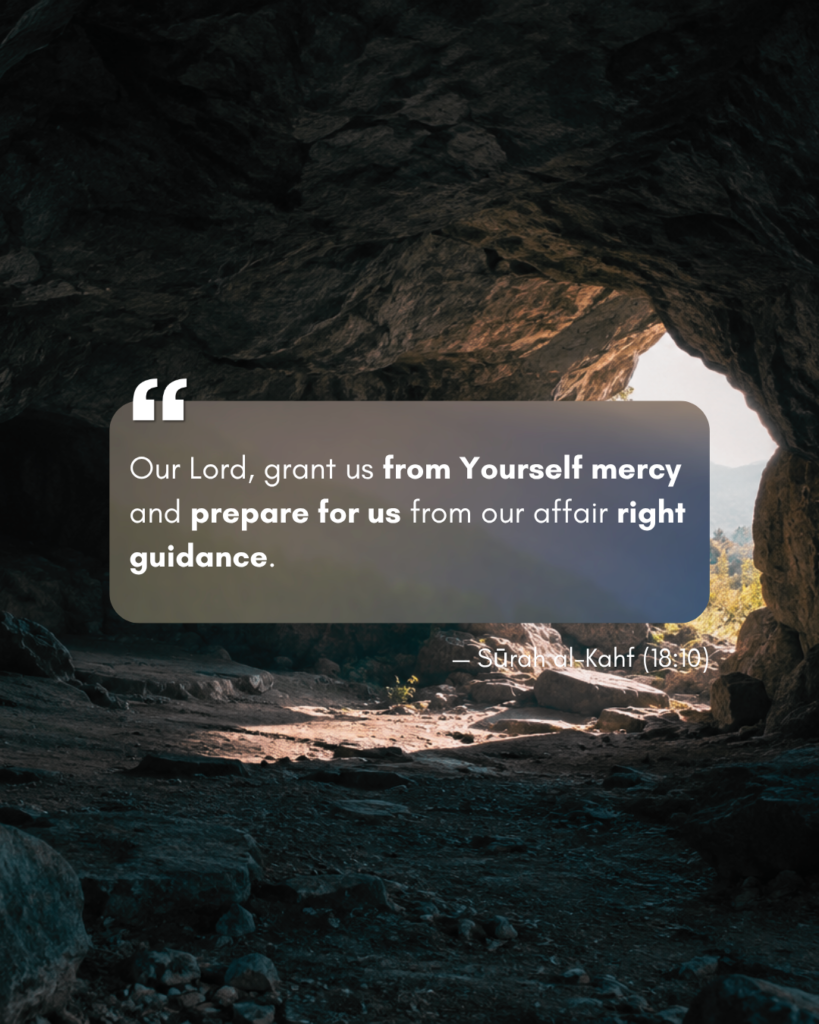
إِذْ أَوَى الْفِتْيَةُ إِلَى الْكَهْفِ فَقَالُوا رَبَّنَا آتِنَا مِن لَّدُنكَ رَحْمَةً وَهَيِّئْ لَنَا مِنْ أَمْرِنَا رَشَدًا
Idh awal-fityatu ilal-kahfi fa-qālū Rabbanā ātinā min ladunka raḥmataw-wa hayyi’ lanā min amrinā rashadā.
“When the youths retreated to the cave and said, ‘Our Lord, grant us from Yourself mercy and prepare for us from our affair right guidance.’”
— Sūrah al-Kahf (18:10)
Stand where they stood. The city is behind you, with the provision, the belonging, the expectations of everyone who knew you. Ahead is rock and dark. Whatever you would have arranged, you can no longer arrange. And out of that position comes a prayer that is astonishingly short.
Rabbanā ātinā min ladunka raḥmatan. Ibn Kathīr raḥimahullāh explains that they asked for a mercy from Allāh with which He would have mercy on them and conceal them from their people. Concealment. The first thing they asked for was to be hidden from a world they could not fight.
Wa hayyi’ lanā min amrinā rashadan. Ibn Kathīr raḥimahullāh takes this to mean: make the end of our matter rashad, right guidance, a good outcome. He links it to the words of the supplication reported in the ḥadīth: wa mā qaḍayta lanā min qaḍā’in fa-jʿal ʿāqibatahu rashadā, whatever You decree for us, make its end rightly guided.
Now notice what is not in the du’ā. They do not ask for food. They do not ask for safety, for a way back, for the tyrant to fall, or for a timeline. They do not ask to be told how it ends. They ask that whatever Allāh decrees, He make its ending right. That is the du’ā of a person who has stopped trying to manage the outcome and handed the ending to the One who writes it.
And this is where rashad touches the perception. It is not only a good ending. It is an eye that sees through the zīnah and a heart that conceives of reality the way Allāh ʿazza wa jall has described it. The youths had been shown a city that taught a false picture of the world, and they refused to keep feeding that picture into their hearts. The cave was not just a hiding place from people. It was a place where the inputs changed and the heart could be retrained on what was true: Rabbunā Rabbus-samāwāti wal-arḍ. Not the king. Not the wealth. Not the self.
And look at the du’ā itself. When they had encouraged one another to retreat, they had already said that their Lord would spread out for them of His mercy and prepare for them from their affair facility (18:16). That was their good opinion of Him, spoken before they had anything to show for it. And in the cave, they asked Him for exactly that: raḥmah and hayyi’ lanā min amrinā. The same roots, the same confidence, now turned into a request. They did not invent a request in the dark and hope for the best. They asked their Lord for what they had already trusted Him to do.
The Answer
فَضَرَبْنَا عَلَىٰ آذَانِهِمْ فِي الْكَهْفِ سِنِينَ عَدَدًا
Fa-ḍarabnā ʿalā ādhānihim fil-kahfi sinīna ʿadadā.
“So We cast [a cover of sleep] over their ears within the cave for a number of years.”
— Sūrah al-Kahf (18:11)
They asked to be concealed, and Allāh concealed them. He put them to sleep. There was no sound for the city to trace, no footsteps, no food to buy, no lamp to see. Their protection was to be hidden in a way no human means could have produced.
وَتَرَى الشَّمْسَ إِذَا طَلَعَت تَّزَاوَرُ عَن كَهْفِهِمْ ذَاتَ الْيَمِينِ وَإِذَا غَرَبَت تَّقْرِضُهُمْ ذَاتَ الشِّمَالِ وَهُمْ فِي فَجْوَةٍ مِّنْهُ ۚ ذَٰلِكَ مِنْ آيَاتِ اللَّهِ ۗ مَن يَهْدِ اللَّهُ فَهُوَ الْمُهْتَدِ ۖ وَمَن يُضْلِلْ فَلَن تَجِدَ لَهُ وَلِيًّا مُّرْشِدًا
“And [had you been present], you would see the sun when it rose, inclining away from their cave on the right, and when it set, passing away from them on the left, while they were in an open space thereof. That is from the signs of Allāh. Whoever Allāh guides, he is the guided one, and whoever He sends astray, never will you find for him a protecting guide.”
— Sūrah al-Kahf (18:17)
Ibn Kathīr raḥimahullāh explains that this was a mercy from Allāh, preserving their bodies while they slept, keeping the cave ventilated without direct sunlight touching them. What they asked for from Allāh’s special presence was arranged down to the angle of the sun.
They stayed three hundred years and nine more (18:25). When Allāh raised them, the world had turned over. One went out with his coins to buy food, and the currency was strange to the people who saw it. The one who asked for a good ending was given an ending that became a sign for everyone who came after:
وَكَذَٰلِكَ أَعْثَرْنَا عَلَيْهِمْ لِيَعْلَمُوا أَنَّ وَعْدَ اللَّهِ حَقٌّ وَأَنَّ السَّاعَةَ لَا رَيْبَ فِيهَا
“And similarly, We caused them to be found that they [the people] would know that the promise of Allāh is truth and that of the Hour there is no doubt.”
— Sūrah al-Kahf (18:21)
Rashad was not only their safety. It was that their story became proof that Allāh’s promise is true.
The Question Allāh Told Us Not to Chase
Then the sūrah turns, in the middle of the story, to the argument going on around the story:
سَيَقُولُونَ ثَلَاثَةٌ رَّابِعُهُمْ كَلْبُهُمْ وَيَقُولُونَ خَمْسَةٌ سَادِسُهُمْ كَلْبُهُمْ رَجْمًا بِالْغَيْبِ ۖ وَيَقُولُونَ سَبْعَةٌ وَثَامِنُهُمْ كَلْبُهُمْ ۚ قُل رَّبِّي أَعْلَمُ بِعِدَّتِهِم مَّا يَعْلَمُهُمْ إِلَّا قَلِيلٌ
Sa-yaqūlūna thalāthatun rābiʿuhum kalbuhum wa yaqūlūna khamsatun sādisuhum kalbuhum rajmam bil-ghayb, wa yaqūlūna sabʿatun wa thāminuhum kalbuhum. Qul Rabbī aʿlamu bi-ʿiddatihim mā yaʿlamuhum illā qalīl.
“They will say there were three, the fourth of them being their dog; and they will say there were five, the sixth of them being their dog, guessing at the unseen; and they will say there were seven, and the eighth of them was their dog. Say: My Lord is most knowing of their number. None knows them except a few.”
— Sūrah al-Kahf (18:22)
Ibn Kathīr raḥimahullāh explains that Allāh reports three views and weakens the first two with rajman bil-ghayb, guessing at the unseen, while not attaching that phrase to the third. He notes that the chains of reports from Ibn ʿAbbās saying they were seven are ṣaḥīḥ, and this is the sound view.
Pause on that. Here are people preserved for three centuries by a mercy that reached into the angle of the sun, and around them the world is arguing about how many there were and what the dog was doing. Someone can spend a lifetime on the headcount and arrive at the end without having heard the du’ā, the withdrawal, or the mercy. Allāh placed this warning in the middle of the story so it could not be walked past.
And What About Us?
Every era has its Firʿawn. Sometimes it is a person. Sometimes it is a system that says: participate on our terms, or lose your place. Mūsā ʿalayhissalām was sent to Firʿawn and commanded to go to him directly. The youths of the cave were given no such command, and they had no such power. What was demanded of them was compromise. And Allāh ʿazza wa jall did not leave them without a door. He named the cave and called it a place of His mercy.
Rasūlullāh ﷺ pointed to the same door for a later time:
«يُوشِكُ أَنْ يَكُونَ خَيْرَ مَالِ الْمُسْلِمِ غَنَمٌ يَتْبَعُ بِهَا شَعَفَ الْجِبَالِ وَمَوَاقِعَ الْقَطْرِ، يَفِرُّ بِدِينِهِ مِنَ الْفِتَنِ»
“It is near that the best property of a man will be sheep, which he follows to the peaks of the mountains and places of rainfall, fleeing with his religion from tribulations (fitan).”
— Abū Saʿīd al-Khudrī raḍiyallāhu ʿanhu. Recorded by al-Bukhārī (19) and Ṣaḥīḥ Ibn Mājah (3230). Graded ṣaḥīḥ by Shaykh al-Albānī raḥimahullāh.
Note the phrase yafirru bi-dīnihi, fleeing with his dīn. Both stories agree on what is being carried out: not the man, not the wealth, but the dīn. Everything else is merely the vehicle by which it is preserved.
Not every believer, and not every fitnah, calls for this. That is a question for people of knowledge. But the door is real, and it was left open on purpose.
Most of us did not grow up knowing this story. We knew the trivia. Five, six, seven, and a dog. The numbers reached us. The du’ā had to be sought. And many of us never went looking. But the greater danger is not that we missed the story. It is that we know what it says and still do not act on it.
We know what is ḥarām. We do not deny it, but we keep it, rebrand it, or rationalize it. We know when the income is untoward. We know the industry runs on what Allāh called rijs meaning Shayṭān’s handiwork. We know the ruling did not change when the label did. And we tell ourselves the same thing Firʿawn’s people told themselves, dressed in the language of the modern world: everyone is doing this. How will we survive if we don’t? How will we provide for our families if we walk away?
That sentence is not a market analysis. It is a verdict on al-Qadīr. It claims, quietly, that the One who swore provision is certain cannot be trusted without the very things He declared war upon.
This is precisely what the youths of the cave rejected. When the city demanded compromise, they did not stay and negotiate. They withdrew. They took the step. Nothing in these āyāt suggests they felt no fear. We can be certain something is wrong and still feel the full weight of walking away: the income, the name, the people who depend on us and the ones who will not understand, the numbers that do not add up, and the voice at night asking what happens if it fails. The nafs is not silenced by knowing; it is answered by trust.
And Allāh answers that voice directly:
وَفِي السَّمَاءِ رِزْقُكُمْ وَمَا تُوعَدُونَ
Wa fis-samā’i rizqukum wa mā tūʿadūn.
“And in the heaven is your provision and whatever you are promised.”
— Sūrah al-Dhāriyāt (51:22)
Ibn Kathīr raḥimahullāh reports from Ibn ʿAbbās and Mujāhid that the provision in the heaven is the rain, and what you are promised is Paradise. The man in the ḥadīth follows the sheep to mawāqiʿ al-qaṭr, the places where the rain falls. He is not chasing a market. He is following the rain.
Al-Ḥasan al-Baṣrī raḥimahullāh, as al-Qurṭubī reports in his tafsīr on this āyah, would look at the clouds and tell his companions that their provision was in them, but that they were being kept from it by their sins. Read that beside the youths: as a reflection, their leaving was in part a turning away from what displeases Allāh, and what met them was mercy.
Then comes the oath:
فَوَرَبِّ السَّمَاءِ وَالْأَرْضِ إِنَّهُ لَحَقٌّ مِّثْلَ مَا أَنَّكُمْ تَنطِقُونَ
Fa-wa Rabbis-samā’i wal-arḍi innahū la-ḥaqqum mithla mā annakum tanṭiqūn.
“Then by the Lord of heaven and earth, indeed, it is truth, just as certain as it is that you are speaking.”
— Sūrah al-Dhāriyāt (51:23)
Allāh swears by Himself that the matter is as certain as our own speech. We do not doubt that we are speaking right now. We do not need a verse to prove it. He placed our sustenance in that exact category of certainty to close the matter for a fearful heart. I read this oath, as a personal reflection, as more than comfort: it reads as though He knows how heavy the fear is, and wanted the matter closed. Indeed, my Lord knows that which is revealed and that which is concealed, including the anxiety of His slaves.
So the question is not whether the provision is certain. It is certain. The question is why an oath from the Lord of the heavens and the earth does not move us the way a paycheck does.
If the world will not let us keep our dīn inside it, the cave is still open. Rasūlullāh ﷺ named the same door for a later time, when he said the best wealth of a Muslim would be sheep he takes to the mountain peaks and the places of rainfall, fleeing with his dīn from the trials (al-Bukhārī 19).
The mountains and the places of rainfall are the modern cave. They are the same withdrawal the youths made, in a different form. The step is the same step. And the One who answered their du’ā, and swore to them about provision, and spread His mercy over them before they even asked, is the same One today.
The provision was in the heavens before the cave was chosen. The mercy was waiting before the du’ā was made. The only thing that ever had to move was the step.
And it still is.
Yā Rabb, grant us mercy from Your presence, a mercy that sees through the zīnah and does not depend on what we have arranged for ourselves.
Yā Rabb, whatever You decree for us, make its ending right guidance.
Yā Rabb, bind our hearts as You bound theirs, so that when we must stand for the truth, the steadfastness is from You and not from our own resolve.
Yā Rabb, make a way out for every believer who is choosing between their dīn and their income, and let their leaving be answered by Your mercy.
Yā Rabb, You swore by Yourself that the provision is certain. We believe You. Do not let fear of what comes next stop those of us who are required to leave what is wrong.
Yā Rabb, let us never be among those who argued about the number and missed the mercy, neither among those who doubted Your word, and Your word is the truth.
Rabbanā ātinā min ladunka raḥmataw wa hayyi’ lanā min amrinā rashadā.
Āmīn yā Rabb al-ʿĀlamīn, bi-raḥmatika yā Arḥam ar-Rāḥimīn.
A Note on Sources and Verification
Qur’ānic text. All āyāt are linked to quran.com. English renderings are translations of meaning.
Tafsīr. The explanations attributed to Ibn Kathīr raḥimahullāh are drawn from Tafsīr al-Qur’ān al-ʿAẓīm and linked to his commentary on the relevant āyah at quran.com. The statement of al-Ḥasan al-Baṣrī raḥimahullāh is drawn from al-Qurṭubī raḥimahullāh’s Arabic tafsīr on Sūrah al-Dhāriyāt (51:22), linked above. As it is available only in Arabic on quran.com, readers are directed to that link accordingly.
Ibn Kathīr raḥimahullāh on 76:2. The explanation of al-amshāj as the mixing of the man’s fluid with the woman’s fluid is recorded from Ibn ʿAbbās raḍiyallāhu ʿanhu, ʿIkrimah, Mujāhid, al-Ḥasan, and al-Rabīʿ ibn Anas. The explanation of nabtalīhi as “that We may test him,” and of fa-jaʿalnāhu samīʿan baṣīrā as hearing and sight being granted so that through them the servant is capable of obedience and disobedience, is recorded in the same commentary.
The reflection on zīnah, ghiṭā’, and nabtalīhi. The connection between Sūrah al-Kahf (18:7), Sūrah Qāf (50:22) is a reflection I first encountered in the work of contemporary students of knowledge and daʿīs, including Ustad Hisham Abu Yusuf and brother Ousama Alshurafa, and it is explored at length in my own book, The Platform: Seeing Through Life’s Tests & Deceptions. It is offered here as a reflection on the āyāt, not as a tafsīr attribution to a classical scholar, and Allāh knows best. The observation on the sequence in 18:13, that they were fityah and then believed, and that the difficulty of youth makes that sequence significant, is drawn from contemporary students of knowledge and is offered as a reflection on the āyah, not as a tafsīr ruling.
Reflections that are mine. The observation that the du’ā asks for no food or safety but only a good ending, the parallel between the du’ā and the promise in 18:16, the reading of the oath in 51:23, the contrast between Mūsā ʿalayhissalām and the youths, and the application of the perception reflection to rashad are my own and are offered as reflections, not as tafsīr rulings. Where a matter requires a ruling, it belongs to scholars.
Ḥadīth. The ḥadīth of the sheep (Abū Saʿīd al-Khudrī raḍiyallāhu ʿanhu) is recorded in Ṣaḥīḥ al-Bukhārī (19) and Ṣaḥīḥ Ibn Mājah (3230), graded ṣaḥīḥ by Shaykh al-Albānī raḥimahullāh.
Any good in this article is from Allāh alone; any shortcoming is from my own weakness.
And Allāh knows best.