﷽
Before there was a sea that closed over a king, before there was a tongue burned by a coal placed in an infant’s hand, before there was a young people believing while afraid, facing Firʿawn’s oppression, the very thing they feared still standing over them, there was an order given twice in one household: kill the sons, and let the daughters live to watch it happen.
The Qur’ān speaks plainly of Firʿawn’s oppression. It names it. It describes it in precise, recorded detail across many sūrahs, from different angles, at different moments in his life. To understand what the young believers of Banū Isrā’īl were asking to be saved from when they said Rabbanā lā tajʿalnā fitnatal-lil-qawmiẓ-ẓālimīn, we have to first know who the ẓālimīn were. We have to know this man.
The Ruler Who Killed the Children
Long before Mūsā ʿalayhissalām was born, Firʿawn had already turned the birth of children into an instrument of terror. He had been warned, as Ibn Kathīr raḥimahullāh records in al-Bidāyah wa al-Nihāyah, that a boy from among Banū Isrā’īl would arise and bring about the destruction of his kingdom. His response was the response of a man who believed that the decrees of Allāh ʿazza wa jall could be intercepted by sufficient human cruelty: he ordered the killing of every male child born to Banū Isrā’īl.
Allāh ʿazza wa jall records this in Sūrah al-Baqarah, placing it among the greatest trials He reminds Banū Isrā’īl of.
وَإِذْ نَجَّيْنَاكُم مِّنْ آلِ فِرْعَوْنَ يَسُومُونَكُمْ سُوءَ الْعَذَابِ يُذَبِّحُونَ أَبْنَاءَكُمْ وَيَسْتَحْيُونَ نِسَاءَكُمْ ۚ وَفِي ذَٰلِكُم بَلَاءٌ مِّن رَّبِّكُمْ عَظِيمٌ
Wa idh najjaynākum min āli Firʿawna yasūmūnakum sū’al-ʿadhābi yudhabbihūna abnā’akum wa yastaḥyūna nisā’akum, wa fī dhālikum balā’um-mir-Rabbikum ʿaẓīm.
“And [recall] when We saved you [i.e., your forefathers] from the people of Firʿawn, who afflicted you with the worst torment, slaughtering your [newborn] sons and keeping your females alive. And in that was a great trial from your Lord.”
— Sūrah al-Baqarah (2:49)
Mūsā ʿalayhissalām himself later reminded his people of this same moment.
وَإِذْ قَالَ مُوسَىٰ لِقَوْمِهِ اذْكُرُوا نِعْمَةَ اللَّهِ عَلَيْكُمْ إِذْ أَنجَاكُم مِّنْ آلِ فِرْعَوْنَ يَسُومُونَكُمْ سُوءَ الْعَذَابِ وَيُذَبِّحُونَ أَبْنَاءَكُمْ وَيَسْتَحْيُونَ نِسَاءَكُمْ ۚ وَفِي ذَٰلِكُم بَلَاءٌ مِّن رَّبِّكُمْ عَظِيمٌ
Wa idh qāla Mūsā li-qawmihith-kurū niʿmatallāhi ʿalaykum idh anjākum min āli Firʿawna yasūmūnakum sū’al-ʿadhābi wa yudhabbihūna abnā’akum wa yastaḥyūna nisā’akum, wa fī dhālikum balā’um-mir-Rabbikum ʿaẓīm.
“And [recall, O Children of Isrā’īl], when Mūsā said to his people, ‘Remember the favor of Allāh upon you when He saved you from the people of Firʿawn, who were afflicting you with the worst torment and were slaughtering your [newborn] sons and keeping your females alive. And in that was a great trial from your Lord.'”
— Sūrah Ibrāhīm (14:6)
Transmitted by al-Qurṭubī raḥimahullāh, the word yasūmūna carries the sense of driving an animal relentlessly, afflicting it with sustained, continuous harm. It was not an occasional cruelty. It was systematic. And the specific instrument of that oppression was the murder of sons, in the same year they were born, while the daughters and mothers were kept alive to watch it happen.
Ibn Kathīr raḥimahullāh explains in his commentary on this āyah that the killing was ordered in the year Mūsā ʿalayhissalām would be born, then suspended in the following year, then ordered again, which is why Hārūn ʿalayhissalām, who was older, was born in the year of suspension, and Mūsā ʿalayhissalām was born in the year of killing.
And when Mūsā ʿalayhissalām returned years later as a Prophet with signs from Allāh ʿazza wa jall, Firʿawn renewed the same order.
فَلَمَّا جَاءَهُم بِالْحَقِّ مِنْ عِندِنَا قَالُوا اقْتُلُوا أَبْنَاءَ الَّذِينَ آمَنُوا مَعَهُ وَاسْتَحْيُوا نِسَاءَهُمْ ۚ وَمَا كَيْدُ الْكَافِرِينَ إِلَّا فِي ضَلَالٍ
Fa-lammā jā’ahum bil-ḥaqqi min ʿindinā qālū uqtulū abnā’alladhīna āmanū maʿahū wastaḥyū nisā’ahum, wa mā kaydul-kāfirīna illā fī ḍalāl.
“And when he brought them the truth from Us, they said, ‘Kill the sons of those who have believed with him and keep their women alive.’ But the plan of the disbelievers is not except in error.”
— Sūrah Ghāfir (40:25)
The young believers making this du’ā in Sūrah Yūnus were living under a king who had ordered the killing of the sons of Banū Isrā’īl twice: once when Mūsā ʿalayhissalām was born, and again when Mūsā ʿalayhissalām returned with the truth. Their fathers’ generation had lived through the first round. They were living through the second.
The Coal, the Knot, and the Tyrant’s Mockery
Mūsā ʿalayhissalām was raised inside Firʿawn’s own palace, brought there through the plan of Allāh ʿazza wa jall after his mother placed him in the river.
As a young child in that house, Ibn Kathīr raḥimahullāh records, drawing on the reports of the early scholars of tafsīr in his commentary on Sūrah Ṭā Hā and Sūrah al-Qaṣaṣ in al-Bidāyah wa al-Nihāyah, that Mūsā ʿalayhissalām once reached up and pulled Firʿawn’s beard. Firʿawn, enraged, wanted to kill him. His wife intervened, arguing that the child was too young to act with understanding. To test the question, they placed before the infant two options: a glowing coal and a precious jewel. If he reached for the jewel, it would indicate intelligence and confirm the threat. If he reached for the coal, it would confirm he was acting without awareness.
This account records that an angel directed the hand of Mūsā ʿalayhissalām toward the coal. He grasped it and placed it in his mouth. It burned his tongue, and from that burn came the impediment in his speech, the knot that would sit on his tongue for the rest of his life.
This is the same knot he would later ask Allāh ʿazza wa jall to loosen when the command came to return to Firʿawn. In the du’ā covered in the earlier article in this series, Mūsā ʿalayhissalām said.
رَبِّ اشْرَحْ لِي صَدْرِي ﴿٢٥﴾ وَيَسِّرْ لِي أَمْرِي ﴿٢٦﴾ وَاحْلُلْ عُقْدَةً مِّن لِّسَانِي ﴿٢٧﴾ يَفْقَهُوا قَوْلِي
Rabbi ishraḥ lī ṣadrī. Wa yassir lī amrī. Waḥlul ʿuqdatam-min lisānī. Yafqahū qawlī.
“My Lord, expand for me my chest. And ease for me my task. And untie the knot from my tongue. That they may understand my speech.”
— Sūrah Ṭā Hā (20:25-28)
The knot he was asking Allāh ʿazza wa jall to untie had been placed there by the house of Firʿawn itself. And Firʿawn, years later, would stand before his people and use that same impediment as a weapon of mockery.
أَمْ أَنَا خَيْرٌ مِّنْ هَٰذَا الَّذِي هُوَ مَهِينٌ وَلَا يَكَادُ يُبِينُ
Am anā khayrum-min hādhā alladhī huwa mahīnuẁ-wa lā yakādu yubīn.
“Am I not better than this one who is insignificant and hardly makes himself clear?”
— Sūrah az-Zukhruf (43:52)
Ibn Kathīr raḥimahullāh notes in his commentary on this āyah that Firʿawn (may Allāh curse him) weaponized Mūsā ʿalayhissalām’s speech impediment in an attempt to diminish his standing, fabricating and exaggerating a flaw before the public that Allāh had already cured when He granted Mūsā ʿalayhissalām’s duʿā: “You have been granted your request, O Mūsā.”
In a striking display of malice, the tyrant took the very wound caused under his own roof and paraded it as a public argument against the man he inflicted it upon. This is who this man was.
The Ignorant Man Who Called Himself al-Aʿlā
Firʿawn’s arrogance did not stop at killing children or mocking prophets. He made the claim that sits at the furthest extreme of human deviation: he declared himself the highest lord.
فَقَالَ أَنَا رَبُّكُمُ الْأَعْلَىٰ
Fa-qāla anā Rabbukumul-Aʿlā.
“And he said, ‘I am your lord, the most high.'”
— Sūrah an-Nāziʿāt (79:24)
And before his court, he went further still.
وَقَالَ فِرْعَوْنُ يَا أَيُّهَا الْمَلَأُ مَا عَلِمْتُ لَكُم مِّنْ إِلَٰهٍ غَيْرِي
Wa qāla Firʿawnu yā ayyuhal-mala’u mā ʿalimtu lakum min ilāhin ghayrī.
“And Firʿawn said, ‘O eminent ones, I have not known you to have a god other than me.'”
— Sūrah al-Qaṣaṣ (28:38)
And to Mūsā ʿalayhissalām directly.
قَالَ لَئِنِ اتَّخَذْتَ إِلَٰهًا غَيْرِي لَأَجْعَلَنَّكَ مِنَ الْمَسْجُونِينَ
Qāla la’inittakhadhta ilāhan ghayrī la-ajʿalannaka minal-masjūnīn.
“He said, ‘If you take a god other than me, I will surely make you one of the imprisoned.'”
— Sūrah ash-Shuʿarā’ (26:29)
Ibn Kathīr raḥimahullāh records in his commentary on this āyah that Allāh seized Firʿawn in exemplary punishment for his rebellion, making his destruction a permanent warning for all tyrants. The man who killed children to prevent the decree of Allāh, who burned the tongue of a prophet in his own household, now stood before his people and declared: “I am your lord, the most high.”
The young believers who submitted ʿalā khawf (out of fear) were living in a land where this self-deification was the official political theology, and where declaring faith in Allāh ʿazza wa jall alone was treated as an act of treason against the state.
The Last Moments of Firʿawn
When the sea split and the Children of Isrā’īl passed through, Firʿawn pursued them. The walls of water closed. And in the moment that the sea overtook him, the Qur’ān records his final declaration.
وَجَاوَزْنَا بِبَنِي إِسْرَائِيلَ الْبَحْرَ فَأَتْبَعَهُمْ فِرْعَوْنُ وَجُنُودُهُ بَغْيًا وَعَدْوًا ۖ حَتَّىٰ إِذَا أَدْرَكَهُ الْغَرَقُ قَالَ آمَنتُ أَنَّهُ لَا إِلَٰهَ إِلَّا الَّذِي آمَنَتْ بِهِ بَنُو إِسْرَائِيلَ وَأَنَا مِنَ الْمُسْلِمِينَ
Wa jāwaznā bi-Banī Isrā’īlal-baḥra fa-atbaʿahum Firʿawnu wa junūduhū baghyaw-wa ʿadwā, ḥattā idhā adrakahuḍ-gharaqu qāla āmantu annahū lā ilāha illā lladhī āmanat bihī Banū Isrā’īla wa ana minal-muslimīn.
“And We took the Children of Isrā’īl across the sea, and Firʿawn and his soldiers followed them in tyranny and enmity until, when drowning overtook him, he said, ‘I believe that there is no deity except that in whom the Children of Isrā’īl believe, and I am of the Muslims.'”
— Sūrah Yūnus (10:90)
Allāh ʿazza wa jall answered him directly.
آلْآنَ وَقَدْ عَصَيْتَ قَبْلُ وَكُنتَ مِنَ الْمُفْسِدِينَ
Āl’āna wa qad ʿaṣayta qablu wa kunta minal-mufsidīn.
“Now? And you had disobeyed before and were of the corrupters.”
— Sūrah Yūnus (10:91)
And Rasūlullāh ﷺ told us what Jibrīl ʿalayhissalām was doing in that same moment. Ibn ʿAbbās raḍiyallāhu ʿanhu narrated that Rasūlullāh ﷺ said.
«لَمَّا أَغْرَقَ اللَّهُ فِرْعَوْنَ، قَالَ: آمَنْتُ أَنَّهُ لاَ إِلَهَ إِلاَّ الَّذِي آمَنَتْ بِهِ بَنُو إِسْرَائِيلَ، فَقَالَ جِبْرِيلُ: يَا مُحَمَّدُ، فَلَوْ رَأَيْتَنِي وَأَنَا آخُذُ مِنْ حَالِ البَحْرِ فَأَدُسُّهُ فِي فِيهِ مَخَافَةَ أَنْ تُدْرِكَهُ الرَّحْمَةُ»
Lammā aghraqa-llāhu Firʿawna, qāla: Āmantu annahū lā ilāha illā-lladhī āmanat bihī Banū Isrāʾīla, fa-qāla Jibrīlu: Yā Muḥammadu, fa-law raʾaytanī wa-anā ākhudhu min ḥāli-l-baḥri fa-adussuhū fī fīhi makhāfata an tudrikahu-r-raḥmah.
“When Allāh drowned Firʿawn, he said: ‘I believe that there is no god but the One in Whom the Children of Isrā’īl believe.’ Jibrīl said: ‘O Muḥammad, if you could have seen me taking mud from the sea and stuffing it in his mouth, out of fear that the mercy would reach him.'”
— Sunan at-Tirmidhī (3107), Ṣaḥīḥ li-ghayrihi by al-Albānī raḥimahullāh, see Mawsūʿat al-Ḥadīth, Dorar.net
Jibrīl ʿalayhissalām, the greatest of the angels, was stuffing mud in the mouth of this man as he drowned. Not out of cruelty, but out of the knowledge that the mercy of Allāh ʿazza wa jall is so vast that even a dying tyrant’s last words could have reached it, and that this man had spent a lifetime actively sealing himself against that mercy. The same mercy the believers asked to be saved by, bi-raḥmatika, was the very thing Jibrīl ʿalayhissalām feared might reach the man who had called himself its master.
And his body was preserved, as Allāh ʿazza wa jall announced.
فَالْيَوْمَ نُنَجِّيكَ بِبَدَنِكَ لِتَكُونَ لِمَنْ خَلْفَكَ آيَةً
Fal-yawma nunajjīka bi-badanika li-takūna li-man khalfaka āyah.
“So today We will save you in body that you may be to those who come after you a sign.”
— Sūrah Yūnus (10:92)
The one who said anā Rabbukumul-Aʿlā was preserved not as a legacy of his divinity, but as a permanent witness against it.
Now We Know Who He Was
This is the Firʿawn under whom the young believers of Banū Isrā’īl were living when Allāh ʿazza wa jall describes them in Sūrah Yūnus. The king who killed children in the year they were born. Who burned a prophet’s tongue in his own household and mocked it publicly decades later. Who declared himself the highest lord and made that declaration the enforced religion of his kingdom. Whose last gasped claim of faith earned him nothing except the mud that Jibrīl ʿalayhissalām pushed between his teeth.
فَمَا آمَنَ لِمُوسَىٰ إِلَّا ذُرِّيَّةٌ مِّن قَوْمِهِ عَلَىٰ خَوْفٍ مِّن فِرْعَوْنَ وَمَلَئِهِمْ أَن يَفْتِنَهُمْ
Fa-mā āmana li-Mūsā illā dhurriyyatum-min qawmihī ʿalā khawfim-min Firʿawna wa mala’ihim ay-yaftina-hum.
“But none believed in Mūsā except some youths from among his people, out of fear of Firʿawn and the eminent ones among them, lest Firʿawn should persecute them.”
— Sūrah Yūnus (10:83)
ʿAlā khawf. Upon fear. Not in spite of fear, not after overcoming fear. They believed while the fear was still present, while nothing in their visible circumstances had shifted, while the sons of believers were still being killed and the man who burned tongues was still on the throne calling himself lord. Their īmān was not a product of safety. It was what they chose to carry while unsafe. And it was to these young people that Mūsā ʿalayhissalām now spoke.
The Command Before the Du’ā
وَقَالَ مُوسَىٰ يَا قَوْمِ إِن كُنتُمْ آمَنتُم بِاللَّهِ فَعَلَيْهِ تَوَكَّلُوا إِن كُنتُم مُّسْلِمِينَ
Wa qāla Mūsā yā qawmi in kuntum āmantum billāhi fa-ʿalayhi tawakkalū in kuntum muslimīn.
“And Mūsā said, ‘O my people, if you have believed in Allāh, then put your trust in Him, if you are Muslims.'”
— Sūrah Yūnus (10:84)
Mūsā ʿalayhissalām does not say: put your trust in Allāh because He will save you immediately. He says: if you have believed, then tawakkul is the necessary consequence. If you are Muslims, submitted ones, then tawakkul is what submission looks like in practice. Ibn Kathīr raḥimahullāh notes in his commentary on this āyah that Allāh ʿazza wa jall combines worship and reliance in many places across the Qur’ān, because the two cannot be separated. He cites the following.
فَاعْبُدْهُ وَتَوَكَّلْ عَلَيْهِ
Fa-ʿbudhu wa tawakkal ʿalayh.
“So worship Him and put your trust in Him.”
— Sūrah Hūd (11:123)إِيَّاكَ نَعْبُدُ وَإِيَّاكَ نَسْتَعِينُ
Iyyāka naʿbudu wa iyyāka nastaʿīn.
“You alone we worship, and You alone we ask for help.”
— Sūrah al-Fātiḥah (1:5)
This connection between worship and reliance is one a believer restates in every rakʿah of every ṣalāh. And tawakkul, as Rasūlullāh ﷺ taught, is not passivity. It is active reliance that still takes the means.
«لَوْ أَنَّكُمْ كُنْتُمْ تَوَكَّلُونَ عَلَى اللَّهِ حَقَّ تَوَكُّلِهِ لَرُزِقْتُمْ كَمَا يُرْزَقُ الطَّيْرُ، تَغْدُو خِمَاصًا وَتَرُوحُ بِطَانًا»
“If you were to rely upon Allāh with true reliance, He would provide for you as He provides for the birds: they go out in the morning hungry and return in the evening full.”
— Sunan at-Tirmidhī (2344), graded ṣaḥīḥ by al-Albānī raḥimahullāh, see Mawsūʿat al-Ḥadīth, Dorar.net
The birds still fly out. The provision comes from Allāh ʿazza wa jall, not from the effort itself, but through it. The young believers making this du’ā were not told to do nothing. They were told to transfer the weight of ultimate reliance from the visible to the One who commands it.
The Du’ā
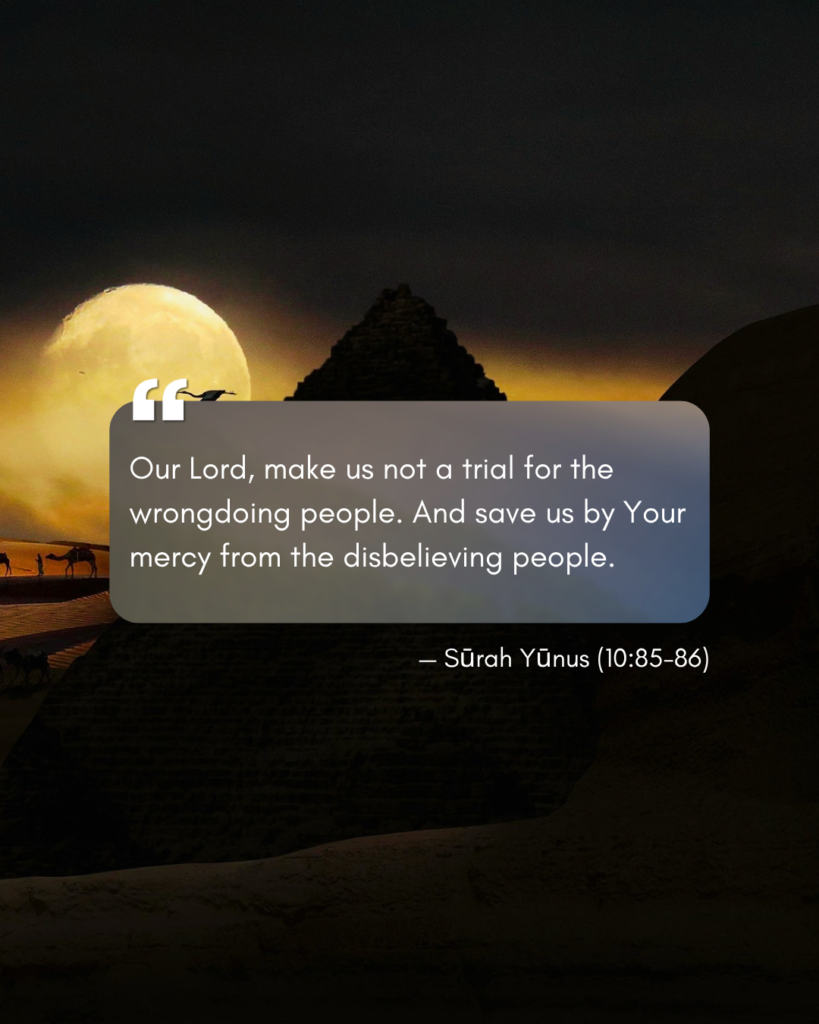
فَقَالُوا عَلَى اللَّهِ تَوَكَّلْنَا رَبَّنَا لَا تَجْعَلْنَا فِتْنَةً لِّلْقَوْمِ الظَّالِمِينَ ﴿٨٥﴾ وَنَجِّنَا بِرَحْمَتِكَ مِنَ الْقَوْمِ الْكَافِرِينَ
Fa-qālū ʿalallāhi tawakkalnā, Rabbanā lā tajʿalnā fitnatal-lil-qawmiẓ-ẓālimīn. Wa najjinā bi-raḥmatika minal-qawmil-kāfirīn.
“And they said, ‘In Allāh we put our trust. Our Lord, make us not a trial for the wrongdoing people. And save us by Your mercy from the disbelieving people.'”
— Sūrah Yūnus (10:85-86)
Their response to Mūsā ʿalayhissalām’s command begins not with a request but with a declaration: ʿalallāhi tawakkalnā, in Allāh we put our trust. They state what they have already placed in Him before they ask for anything. Their asking flows from their trust, rather than their trust being contingent on their asking being answered. Then two requests, each carrying a distinct depth.
First: Rabbanā lā tajʿalnā fitnatan lil-qawmiẓ-ẓālimīn. Ibn Kathīr raḥimahullāh records in his commentary on this āyah, on the authority of Abū Mijlaz, Abū al-Duḥā, and Mujāhid raḥimahullāh through ʿAbd ar-Razzāq, that this means: do not give them victory over us so that they rule us, lest they think they have authority over us because they are on truth and we are on falsehood. That would be a deceiving trial for them.
Now that we know who Firʿawn was, this request carries its full weight. He had already built an entire theology around worldly dominance. He killed children to prevent a decree he had no power to prevent. He mocked a prophet’s tongue with an impediment his own household had caused. He declared himself the highest lord. Every one of these moves was, at its root, a man reading his own power as confirmation of his own divinity.
If Allāh ʿazza wa jall now allowed the believers to remain under his boot indefinitely, Firʿawn would read that too as confirmation. Their subjugation would become another piece of his self-justification. And the young believers understood this, which is why they asked not only for their own protection but for Allāh ʿazza wa jall to prevent their situation from becoming a tool in the hands of a man already drowning in self-deception. They were asking to be protected from producing a deeper confusion in their oppressor, and from allowing that confusion to erode their own certainty about whose side truth was on.
Second: Wa najjinā bi-raḥmatika minal-qawmil-kāfirīn. Ibn Kathīr raḥimahullāh explains in his commentary on this āyah that this means: save us through Your mercy and beneficence from those who denied the truth and covered it, for we have truly believed in You and put our trust in You.
Bi-raḥmatika. By Your mercy. Not by their numbers. Not by their strength. Not by any resource they possessed. They asked to be saved in a way that required only that Allāh ʿazza wa jall be who He is: ar-Raḥīm. This is the deepest kind of tawakkul. Not: Allāh, give us the strength to save ourselves. But: save us, by nothing we bring, only by what You are.
As a personal reflection on the shift in vocabulary between the two requests, the first uses ẓālimīn (wrongdoers) and the second uses kāfirīn (those who conceal and deny). This may reflect a distinction between Firʿawn’s people as wrongdoers in their treatment of the believers, and as disbelievers in their active rejection of the truth of Allāh ʿazza wa jall. The believers were asking to be protected from both dimensions of the oppression: from the political harm of those who wrong them, and from the spiritual corruption that comes from prolonged proximity to those who have denied Allāh ʿazza wa jall entirely.
Allāh ʿazza wa jall answered completely. The sea split, and Firʿawn drowned in the very water he had used as the border of his pursuit. And the mercy the believers asked to be saved by, bi-raḥmatika, was the same mercy Jibrīl ʿalayhissalām prevented from reaching the man who had claimed ownership of it.
The magicians who came to that field as Firʿawn’s professionals and left it as people willing to die for truth, as explored in The Du’ā of the Magicians: When They Saw the Truth, were part of the same answer to the same du’ā. The community asking not to be made a fitnah for the wrongdoers was answered in part through the very experts Firʿawn had brought to destroy them, turning in prostration before the Lord they had been hired to deny.
And What About Us?
We may not live in ancient Egypt, but we live in a world filled with its successors. Every era produces its own Firʿawns.
We see them today in the most horrific, visible manifestations of power: in the slaughter and genocide rained down upon believers in Gaza, across Palestine, Sudan, and Lebanon. And in a painful historical irony, those who claim to be the descendants of those once saved from Firʿawn’s decree have themselves adopted the methods of the tyrant. For the believers witnessing this horror, it remains a profound and painful trial: a raw, modern re-enactment of living under a regime that claims absolute authority over human life.
Yet Firʿawn does not always arrive with armies and iron. Sometimes the tyranny is subtle, creeping silently into how we think, what we value, and how we act.
There is a Firʿawn in the culture of celebrity worship, where believers eagerly follow influencers into ḥarām, imitating their dress, exposing their ʿawrah, and compromising their modesty while still claiming faith. There is a Firʿawn in the modern elevation of science to the position of “the Most High,” where human discovery is treated as absolute truth, forgetting that science is merely a finite lens Allāh ʿazza wa jall grants us to observe His creation. And there is a Firʿawn in the relentless parade of billionaire lifestyles and curated social media perfection, where we scroll through the fakeness, feel small against lives that do not exist, and grow bitter about the blessings we actually have.
Allāh ʿazza wa jall describes this exact state:
إِنَّ الْإِنسَانَ لِرَبِّهِ لَكَنُودٌ
Inna al-insāna li-Rabbihī la-kanūd.
“Indeed, mankind is truly ungrateful to his Lord.”
— Sūrah al-ʿĀdiyāt (100:6)
And He asks:
فَبِأَيِّ آلَاءِ رَبِّكُمَا تُكَذِّبَانِ
Fa-bi-ayyi ālā’i Rabbikumā tukadhdhibān.
“So which of the favors of your Lord would you deny?”
— Sūrah al-Raḥmān (55:13)
Whether it is a dictator claiming the power of life and death, or a secular culture demanding that we bow to its values, or our own hearts measuring themselves against illusions, the fitnah remains identical. The strong conclude their material dominance gives them theological justification. The weak begin to wonder whether their weakness means they are wrong. And the ungrateful forget that the very blessings they resent were given by the One they are ignoring.
This is why the two requests of this duʿā remain our primary spiritual sanctuary.
Yā Rabb, in You we put our trust. We say this as a declaration before we ask for anything, because what we claim to believe ought to come before what we want to receive.
Yā Rabb, do not make us a trial for the wrongdoing people. Do not let our weakness be mistaken, by them or by us, for evidence that falsehood is stronger than truth. Let our situation never become a proof in anyone’s hands against the dīn You sent, and do not let the length of any hardship erode our own certainty in its resolution.
Yā Rabb, save us by Your mercy from the people who have covered the truth. Not by anything we have assembled or earned or deserved. By what You are: ar-Raḥmān, ar-Raḥīm, by the mercy You wrote upon Yourself above Your Throne before the creation existed.
Yā Rabb, make us of those who believe ʿalā khawf, upon fear and not in spite of it, who carry īmān not because the circumstances support it, but because You are sufficient regardless of the circumstances.
Āmīn yā Rabb al-ʿĀlamīn, bi-raḥmatika yā Arḥam ar-Rāḥimīn.
A Note on Sources and Verification
The tafsīr explanations draw from Ibn Kathīr raḥimahullāh’s Tafsīr al-Qur’ān al-ʿAẓīm, accessible through the linked commentaries on quran.com. The attributions to Abū Mijlaz, Abū al-Duḥā, and Mujāhid raḥimahullāh through ʿAbd ar-Razzāq are recorded in Ibn Kathīr’s commentary on Sūrah Yūnus (10:85) and reproduced as recorded there. The explanation of the killing of the sons being ordered in alternate years is drawn from Ibn Kathīr’s commentary on Sūrah al-Baqarah (2:49).
The story of the hot coal placed before the infant Mūsā ʿalayhissalām is recorded by Ibn Kathīr raḥimahullāh in his commentary on Sūrah al-Qaṣaṣ and in al-Bidāyah wa al-Nihāyah, as reproduced in his commentary on Sūrah Ṭā Hā, drawing from the reports of the early scholars of tafsīr. It is presented here as recorded in the classical tafsīr tradition. It includes reports that the early scholars received through chains that may contain Isrā’īliyyāt elements alongside statements of the early Muslims.
I am not a scholar and cannot assess the full isnād of these reports. They are offered as recorded from the classical tafsīr tradition and should be understood as such, not as established ḥadīth with individually verified chains. Ibn Kathīr raḥimahullāh himself notes, at the close of this narration, that it is mawqūf (a report stopping at Ibn ʿAbbās raḍiyallāhu ʿanhu) except for a small portion, and that Ibn ʿAbbās raḍiyallāhu ʿanhu likely received it from what was permissible to relate from Isrā’īliyyāt sources such as Kaʿb al-Aḥbār, wa Allāhu aʿlam.
The ḥadīth of Jibrīl ʿalayhissalām stuffing mud in Firʿawn’s mouth is recorded in Sunan at-Tirmidhī (3107), narrated by Ibn ʿAbbās raḍiyallāhu ʿanhu. At-Tirmidhī described it as ḥasan ṣaḥīḥ gharīb, and its authenticity is affirmed in the linked Dorar.net entry, drawing on al-Albānī raḥimahullāh’s grading. The ḥadīth of the birds is recorded in Sunan at-Tirmidhī (2344), graded ṣaḥīḥ by al-Albānī raḥimahullāh, as recorded in the linked Dorar.net entry.
The observations regarding the shift from ẓālimīn to kāfirīn and the sequencing of the declaration before the requests are personal reflections on the text, clearly identified as such throughout the article, and are not presented as authoritative tafsīr conclusions.
Any good in this article is from Allāh alone; any shortcoming is from my own weakness.
And Allāh knows best.