﷽
Before there was a snake that devoured falsehood, before there was a messenger standing in front of a tyrant, before there was a du’ā of the Magicians, there was a description of the people of a city. And that is a verse in Sūrah al-Aʿrāf that describes the exact terms on which Allāh ʿazza wa jall deals with every people, at every time, including now.
وَلَوْ أَنَّ أَهْلَ الْقُرَىٰ آمَنُوا وَاتَّقَوْا لَفَتَحْنَا عَلَيْهِم بَرَكَاتٍ مِّنَ السَّمَاءِ وَالْأَرْضِ وَلَٰكِن كَذَّبُوا فَأَخَذْنَاهُم بِمَا كَانُوا يَكْسِبُونَ
Wa law anna ahlal-qurā āmanū wattaqaw lafataḥnā ʿalayhim barakātim-minas-samā’i wal-arḍi wa lākin kadhdhabū fa-akhadhnāhum bimā kānū yaksibūn.
“And if only the people of the cities had believed and feared Allāh, We would have opened [i.e., bestowed] upon them blessings from the heaven and the earth; but they denied [the messengers], so We seized them for what they were earning.”
— Sūrah al-Aʿrāf (7:96)
The condition is clear. The result is certain. Īmān and taqwā together are the key that opens blessings from above and from below. Not wealth alone. Not strategy. Not connections or carefully managed circumstances. Ibn Kathīr raḥimahullāh explains in his commentary on this āyah that the blessings here refer to rain from the sky and vegetation from the earth, provision flowing in abundance for a people who have aligned themselves with their Lord.
This is the same principle that runs through the speech of Prophet Hūd ʿalayhissalām to his people:
وَيَا قَوْمِ اسْتَغْفِرُوا رَبَّكُمْ ثُمَّ تُوبُوا إِلَيْهِ يُرْسِلِ السَّمَاءَ عَلَيْكُم مِّدْرَارًا وَيَزِدْكُمْ قُوَّةً إِلَىٰ قُوَّتِكُمْ
Wa yā qawmis-taghfirū rabbakum thumma tūbū ilayhi yursilis-samā’a ʿalaykum midrāraw-wa yazidkum quwwatan ilā quwwatikum.
“And O my people, ask forgiveness of your Lord and then repent to Him. He will send [rain from] the sky upon you in showers and increase you in strength [added] to your strength.”
— Sūrah Hūd (11:52)
And Nūḥ ʿalayhissalām said to his people:
يُرْسِلِ السَّمَاءَ عَلَيْكُم مِّدْرَارًا وَيُمْدِدْكُم بِأَمْوَالٍ وَبَنِينَ وَيَجْعَل لَّكُمْ جَنَّاتٍ وَيَجْعَل لَّكُمْ أَنْهَارًا
Yursilis-samā’a ʿalaykum midrāraw-wa yumdidkum bi-amwāliw-wa banīna wa yajʿal lakum jannātiw-wa yajʿal lakum anhārā.
“He will send [rain from] the sky upon you in [continuing] showers, and give you increase in wealth and children and provide for you gardens and provide for you rivers.”
— Sūrah Nūḥ (71:11-12)
The pattern never changes. The condition is always the same. And it was from sitting with this verse that I understood something about a livelihood I needed to leave, a chapter I needed to close, and a Lord whose promise I had not yet fully trusted.
The People Who Felt Safe
Then Allāh ʿazza wa jall shows us, directly after this promise, what it looks like to reject those terms.
أَفَأَمِنَ أَهْلُ الْقُرَىٰ أَن يَأْتِيَهُم بَأْسُنَا بَيَاتًا وَهُمْ نَائِمُونَ
Afa’amina ahlul-qurā ay-ya’tiyahum ba’sunā bayātaw-wa hum nā’imūn.
“Then, did the people of the cities feel secure from Our punishment coming to them at night while they were asleep?”
— Sūrah al-Aʿrāf (7:97)
أَوَأَمِنَ أَهْلُ الْقُرَىٰ أَن يَأْتِيَهُم بَأْسُنَا ضُحًى وَهُمْ يَلْعَبُونَ
Awa amina ahlul-qurā ay-ya’tiyahum ba’sunā ḍuḥaw-wa hum yalʿabūn.
“Or did the people of the cities feel secure from Our punishment coming to them in the morning while they were at play?”
— Sūrah al-Aʿrāf (7:98)
أَفَأَمِنُوا مَكْرَ اللَّهِ ۚ فَلَا يَأْمَنُ مَكْرَ اللَّهِ إِلَّا الْقَوْمُ الْخَاسِرُونَ
Afa’aminū makrallāh, fa-lā ya’manu makrallāhi illal-qawmul-khāsirūn.
“Then, did they feel secure from the plan of Allāh? But no one feels secure from the plan of Allāh except the losing people.”
— Sūrah al-Aʿrāf (7:99)
At night, while sleeping. In the morning, while playing. Ibn Kathīr raḥimahullāh notes in his commentary on this āyah that the only person who feels entirely safe from Allāh’s plan is the one who has already lost, because it is precisely that sense of safety that keeps them from the īmān and taqwā that would have opened the barakāt of heaven and earth to them.
Then Allāh ʿazza wa jall turns to those who inherited the earth after the destroyed nations and asks the question they had apparently failed to ask themselves:
أَوَلَمْ يَهْدِ لِلَّذِينَ يَرِثُونَ الْأَرْضَ مِن بَعْدِ أَهْلِهَا أَن لَّوْ نَشَاءُ أَصَبْنَاهُم بِذُنُوبِهِمْ
Awa lam yahdi lilladhīna yarithūnal-arḍa mim baʿdi ahlihā al-law nashā’u aṣabnāhum bidhunūbihim.
“Has it not become clear to those who inherited the earth after its [previous] people that if We willed, We could afflict them for their sins?”
— Sūrah al-Aʿrāf (7:100)
Then Allāh ʿazza wa jall instructs Rasūlullāh ﷺ to convey to us one specific example, the example that crystallizes the principle of 7:96 most completely.
Then We Sent Mūsā
ثُمَّ بَعَثْنَا مِن بَعْدِهِم مُّوسَىٰ بِآيَاتِنَا إِلَىٰ فِرْعَوْنَ وَمَلَئِهِ فَظَلَمُوا بِهَا
Thumma baʿathnā mim baʿdihim Mūsā bi-āyātinā ilā Firʿawna wa mala’ihī fa-ẓalamū bihā.
“Then after them We sent Mūsā with Our signs to Firʿawn and his establishments, but they were unjust toward them.”
— Sūrah al-Aʿrāf (7:103)
This is the specific example Allāh ʿazza wa jall chose. Not a people destroyed quietly in the night. The confrontation that produced perhaps the most dramatic single moment of īmān in human history: a group of men who came to a field as professionals hired by a king, and left it, within the span of a single working morning, as believers willing to die for what they had just seen.
When Mūsā ʿalayhissalām stood before Firʿawn and showed him the signs of Allāh ʿazza wa jall, Firʿawn’s response was to summon the finest magicians in Egypt. Ibn Kathīr raḥimahullāh explains in his commentary on Sūrah al-Aʿrāf (7:111-112) that they were gathered from across the land, not a casual assembly, but the most expert practitioners of deception through illusion in the entire kingdom. Firʿawn understood that the only way to defeat Mūsā ʿalayhissalām in the public eye was to produce a spectacle convincing enough to make the people conclude that what they had witnessed was craft rather than miracle.
The Greatest Mistake of a King
Firʿawn made one catastrophic error in this calculation. He brought experts.
وَجَاءَ السَّحَرَةُ فِرْعَوْنَ قَالُوا إِنَّ لَنَا لَأَجْرًا إِن كُنَّا نَحْنُ الْغَالِبِينَ
Wa jā’as-saḥaratu Firʿawna qālū inna lanā la-ajran in kunnā naḥnul-ghālibīn.
“And the magicians came to Firʿawn. They said, ‘Indeed for us is a reward if we are the predominant.'”
— Sūrah al-Aʿrāf (7:113)
They came as professionals, negotiating their fee before the contest had begun. These were men who dealt in deception for a living and knew exactly what deception looked like from the inside. When their staffs and ropes moved across the ground, they knew precisely what mechanism was producing the motion. When Mūsā ʿalayhissalām’s staff moved, they knew something of an entirely different nature was happening.
۞ وَأَوْحَيْنَآ إِلَىٰ مُوسَىٰٓ أَنْ أَلْقِ عَصَاكَ ۖ فَإِذَا هِىَ تَلْقَفُ مَا يَأْفِكُونَ
Wa awhaynā ilā Mūsā an alqi ʿaṣāka fa-idhā hiya talqafu mā ya’fikūn.
“And We inspired to Mūsā, “Throw your staff,” and at once it devoured what they were falsifying.”
— Sūrah al-Aʿrāf (7:117)
The word ya’fikūn carries the meaning of fabricating and falsifying, the particular distortion that inverts truth. Their ropes and staffs moved through craft honed over years of practice. What consumed their craft was not a more sophisticated version of the same thing. As Ibn Kathīr raḥimahullāh records in his commentary on Sūrah al-Aʿrāf (7:120), the magicians realized that this was from heaven and was by no means magic. They fell in prostration. And he also records that Al-Qāsim bin Abī Bazzah raḥimahullāh commented, “They did not raise their heads before seeing the Paradise, the Fire, and the recompense of their inhabitants.”
A Life Pivoted in a Single Prostration
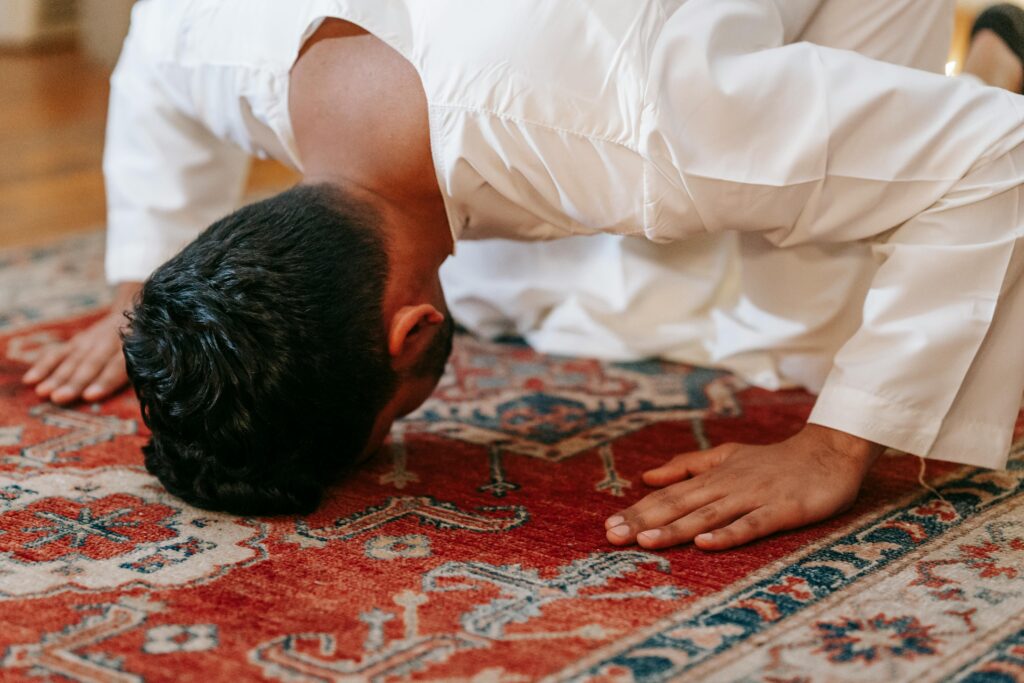
فَأُلْقِيَ السَّحَرَةُ سَاجِدِينَ
Fa-ulqiyas-saḥaratu sājidīn.
“And the magicians fell down in prostration [to Allāh].”
— Sūrah al-Aʿrāf (7:120)
I find myself returning to the passive voice here: ulqiyū, they were cast, they were thrown. It reads, as a personal reflection on the Arabic phrasing, less like a decision made by limbs that chose to bend, and more like a collapse that the weight of truth itself produced in them. These were men who had spent careers manufacturing wonder in the eyes of watching crowds. In a single moment they encountered something genuine, and it put them on the ground.
قَالُوا آمَنَّا بِرَبِّ الْعَالَمِينَ ﴿١٢١﴾ رَبِّ مُوسَىٰ وَهَارُونَ
Qālū āmannā bi-Rabbil-ʿālamīn. Rabbi Mūsā wa Hārūn.
“They said, “We have believed in the Lord of the worlds, the Lord of Mūsā and Hārūn.'”
— Sūrah al-Aʿrāf (7:121-122)
They specified: the Lord of Mūsā and Hārūn. Not a vague statement of belief. A precise identification of the One whose sign they had just witnessed, distinguishing Him clearly from Firʿawn’s own claim to divinity. This was not the language of men leaving themselves an escape route.
In Sūrah ash-Shuʿarāʾ, they go further still:
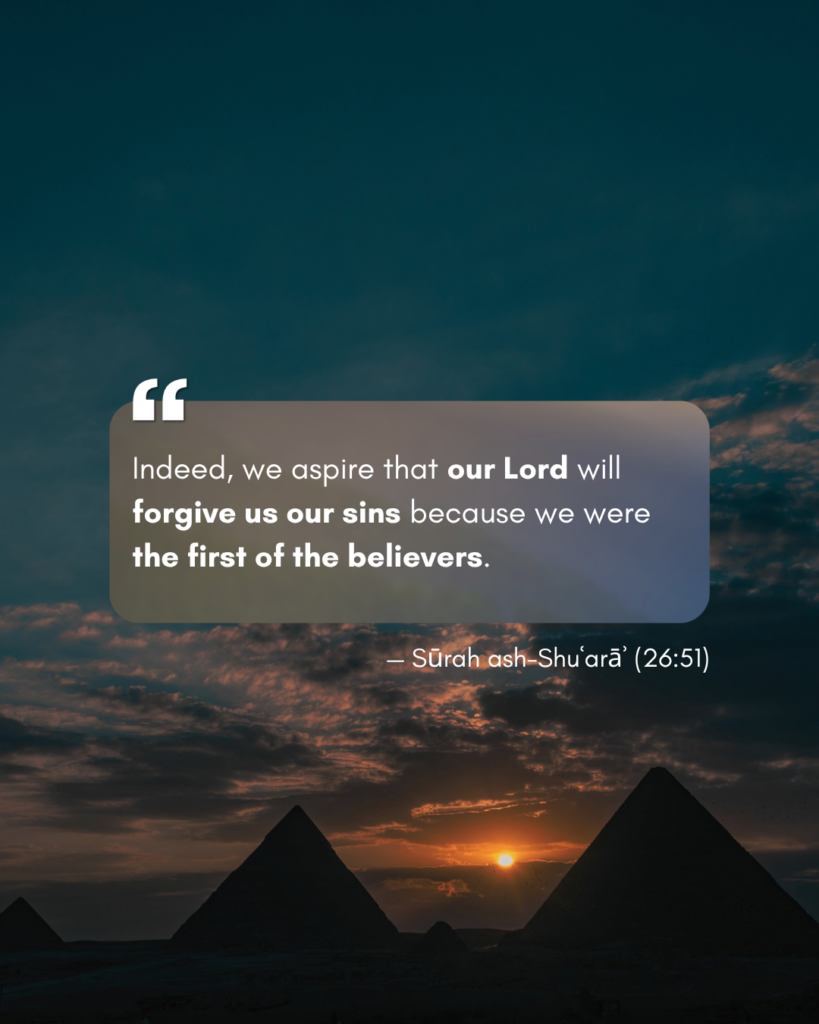
إِنَّا نَطْمَعُ أَن يَغْفِرَ لَنَا رَبُّنَا خَطَايَانَا أَن كُنَّا أَوَّلَ الْمُؤْمِنِينَ
Innā naṭmaʿu ay-yaghfira lanā rabbunā khaṭāyānā an kunnā awwalal-mu’minīn.
“Indeed, we aspire that our Lord will forgive us our sins because we were the first of the believers.”
— Sūrah ash-Shuʿarāʾ (26:51)
They had come as the first to be hired to defeat Mūsā ʿalayhissalām. They left hoping to be the first of the believers. And this moment was itself, as a reflection on the sequence of events in the same story, the answer to the du’ā Mūsā ʿalayhissalām had already made, Rabbi ishraḥ lī ṣadrī, open my chest, ease my task, delivered not through an army or visible force, but through the instant submission of the very men sent to destroy him.
The Threat, The Du’ā, The Answer
Firʿawn’s response was immediate.
قَالَ فِرْعَوْنُ آمَنتُم بِهِ قَبْلَ أَن آذَنَ لَكُمْ ۖ إِنَّ هَٰذَا لَمَكْرٌ مَّكَرْتُمُوهُ فِي الْمَدِينَةِ لِتُخْرِجُوا مِنْهَا أَهْلَهَا ۖ فَسَوْفَ تَعْلَمُونَ
Qāla Firʿawnu āmantum bihī qabla an ādhana lakum, inna hādhā la-makrum makartumūhu fil-madīnati li-tukhrijū minhā ahlahā, fa-sawfa taʿlamūn.
“Firʿawn said, ‘You believed in him before I gave you permission. Indeed, this is a conspiracy which you conspired in the city to expel therefrom its people. But you are going to know.'”
— Sūrah al-Aʿrāf (7:123)
لَأُقَطِّعَنَّ أَيْدِيَكُمْ وَأَرْجُلَكُم مِّنْ خِلَافٍ ثُمَّ لَأُصَلِّبَنَّكُمْ أَجْمَعِينَ
La’uqaṭṭiʿanna aydiyakum wa arjulakum min khilāfin thumma la’uṣallibannakum ajmaʿīn.
“I will surely cut off your hands and your feet on opposite sides; then I will surely crucify you all.”
— Sūrah al-Aʿrāf (7:124)
Consider what these men had walked into the field with that morning. A profession. A reputation as the finest in their craft. A contract with the most powerful ruler on earth, with the pay already negotiated. And within a single working morning, they stood before that same ruler and heard him describe in exact detail how their bodies would be destroyed and displayed.
They had lost everything the world had given them. In exchange, they had received something the world cannot give and cannot take away.
وَمَا تَنقِمُ مِنَّا إِلَّا أَنْ آمَنَّا بِآيَاتِ رَبِّنَا لَمَّا جَاءَتْنَا ۚ رَبَّنَا أَفْرِغْ عَلَيْنَا صَبْرًا وَتَوَفَّنَا مُسْلِمِينَ
Wa mā tanqimu minnā illā an āmannā bi-āyāti rabbinā lammā jā’atnā. Rabbanā afrigh ʿalaynā ṣabraw-wa tawaffanā muslimīn.
“And you do not resent us except because we believed in the signs of our Lord when they came to us. Our Lord, pour upon us patience and let us die as Muslims [in submission to You].”
— Sūrah al-Aʿrāf (7:126)
Before the du’ā itself, they make a declaration. Wa mā tanqimu minnā illā an āmannā: you resent us for nothing except that we believed. They named the precise charge Firʿawn held against them without apology or retreat.
Then: Rabbanā afrigh ʿalaynā ṣabrā. Our Lord, pour upon us patience.
We have met this word before: the believers who stood before Jālūt said Rabbanā afrigh ʿalaynā ṣabrā. The magicians say the same thing, before a different enemy. The verb afrigh in Arabic carries the sense of emptying a vessel completely, not aʿṭinā, give us some, but pour all of it out. Ibn Kathīr raḥimahullāh explains in his commentary on this āyah: ‘We will observe patience in the face of your punishment today, so that we are saved from Allah’s torment… Our Lord! pour out on us patience, with your religion and being firm in it.’
They knew exactly what was coming. They were not asking for the torture to be removed. They were asking for the capacity to endure it without retreating from what they now knew to be true.
And then: wa tawaffanā muslimīn. Let us die as Muslims.
Let us die in this state, this state of submission, this state of having seen the truth and chosen it. The men who had spent their professional lives making falsehood look like truth were now asking only to carry truth into their death.
They came as magicians. They left as shuhadā’.
Allāh ʿazza wa jall does not leave the question of what followed unanswered. In Sūrah Ṭā Hā, as Ibn Kathīr raḥimahullāh records in his commentary on (20:73), the magicians declared before the end:
إِنَّا آمَنَّا بِرَبِّنَا لِيَغْفِرَ لَنَا خَطَايَانَا وَمَا أَكْرَهْتَنَا عَلَيْهِ مِنَ السِّحْرِ ۗ وَاللَّهُ خَيْرٌ وَأَبْقَىٰ
Innā āmannā bi-Rabbinā li-yaghfira lanā khaṭāyānā wa mā akrahtanā ʿalayhi minas-siḥr, wallāhu khayrun wa abqā.
“Indeed, we have believed in our Lord that He may forgive us our sins and what you compelled us [to do] of magic. And Allāh is better and more enduring.”
— Sūrah Ṭā Hā (20:73)
Wallāhu khayrun wa abqā. Allāh is better and more enduring. They had weighed what Firʿawn offered against what Allāh ʿazza wa jall offered and they had reached this conclusion. Their profession, their contract, their safety, their bodies: all of it was less than what they had just received. And all of it would end sooner.
And What About Us?
The magicians did not have years to deliberate. They had minutes. Between the moment they saw Mūsā ʿalayhissalām’s staff consume their ropes and the moment they prostrated, very little time passed. And in that very little time they made one of the most costly decisions any human being can make: they chose the truth at the exact price the truth was being offered.
Most of us do not face Firʿawn. Most of us will not be asked to pay for our faith with our bodies. But we are asked, regularly, quietly, and in ways we can easily avoid acknowledging, to pay for it with something. A livelihood that runs on what Allāh ʿazza wa jall has forbidden. A business built on concealment. A transaction that would profit more if it were dishonest.
Rasūlullāh ﷺ made the arithmetic of this calculation extremely clear:
“The buyer and the seller have the option [to cancel the sale] as long as they have not separated. If they are truthful and make things clear, they will be blessed in their sale. But if they lie and conceal, the blessing of their sale will be erased.”
— Ṣaḥīḥ al-Bukhārī (2079), Ṣaḥīḥ Muslim (1532)
And for those who persist in dishonest dealing, Rasūlullāh ﷺ warned:
ثَلاثةٌ لا يُكَلِّمُهمُ اللهُ يَومَ القيامةِ، ولا يَنظُرُ إليهم ولا يُزَكِّيهم ولَهم عَذابٌ أليمٌ، قال: فقَرَأها رَسولُ اللهِ صلَّى اللهُ عليه وسلَّم ثَلاثَ مِرار، قال أبو ذَرٍّ: خابوا وخَسِروا، مَن هُم يا رَسولَ اللهِ؟ قال: المُسبِلُ، والمَنَّانُ، والمُنَفِّقُ سِلعَتَه بالحَلِفِ الكاذِبِ.
“Three are those whom Allah will not speak to on the Day of Resurrection, nor look at them, nor purify them, and they will have a painful punishment.” He said: So the Messenger of Allah (peace be upon him) recited it three times. Abu Dharr said: “They are ruined and lost. Who are they, O Messenger of Allah?” He said: “The one who lets his garment hang down (below the ankles), the one who reminds others of his favors, and the one who markets his goods with false oaths”
— Ṣaḥīḥ Muslim (106)
The barakāt of 7:96 are not available to the transaction built on deceit. They are available to the one who chooses honesty even when dishonesty would have been more profitable. What appears to be a loss when we choose Allāh ʿazza wa jall over the earnings of falsehood is not a loss at all. It is the very act of īmān and taqwā that opens the barakāt that falsehood could never have produced anyway. I say this not as a scholar but as someone who has lived the weight of this verse, who has stood in the gap between the leaving and the arrival, and who is still trusting the same promise the magicians trusted: wallāhu khayrun wa abqā.
Pivoting from an environment of sin is rarely as sudden as it was for the magicians. For most of us it comes more slowly, through a growing recognition that what we have been building cannot be placed before Allāh ʿazza wa jall without shame. But when that moment of recognition comes, their du’ā is the right one to carry into it. Not rescue. Not a plan. Not a guarantee of how things will work out on the other side. Just: afrigh ʿalaynā ṣabrā, pour completely upon us the patience to stand where we now stand, and tawaffanā muslimīn, let us leave this world in the same state of submission we just chose.
Yā Rabb, we ask You by the same Name they called upon: Rabbanā. Our Lord. The One who receives those who turn to Him, however late they turn and however much they carried before they did.
Yā Rabb, pour upon us patience, not a portion sufficient for today, but the overflowing kind, the kind that does not depend on the outcome being visible before the patience arrives.
Yā Rabb, open for us the barakāt of heaven and earth that You promised to those who believe and have taqwā. Let what we left for Your sake be replaced, as You have always replaced what is left for You, with something better and more lasting.
Yā Rabb, do not let us be among those who inherited the earth from those before them and still felt safe, still played, still slept, without asking whether what they were building would hold when placed before You.
Yā Rabb, do not let us be among those whose transaction is not blessed because they chose concealment over clarity and profit over truth. Make us of those whose dealings are honest before You first, knowing that Your blessing in an honest transaction exceeds whatever we thought we were gaining through a dishonest one.
Yā Rabb, just as the magicians were cast into prostration by the truth they saw, cast our hearts into submission before the truths we already know, so that knowing them and living them are no longer two different things.
Yā Rabb, let our final state be the one we chose when we last chose You. Let us die as Muslims, as people in submission to You, as people whose last pivot was toward You and who never pivoted back.
Wa tawaffanā muslimīn.
Āmīn yā Rabb al-ʿĀlamīn, bi-raḥmatika yā Arḥam ar-Rāḥimīn.
A Note on Sources and Verification
The tafsīr references throughout this article draw from Ibn Kathīr raḥimahullāh’s Tafsīr al-Qurʾān al-ʿAẓīm, accessed through the linked commentaries on quran.com. Any lesson or reflection drawn beyond what the scholars explicitly stated is my own and should be understood as such, not as tafsīr of Allāh’s words but as beneficial reflection grounded in established scholarship. The observation regarding the passive verb ulqiyū (they were cast down) in 7:120 is a personal reflection on the Arabic phrasing and is not presented as an authoritative tafsīr ruling. The linguistic note that afrigh carries the sense of emptying completely rather than merely giving is based on the root meaning of fa-ra-gha in classical Arabic, which is well-attested in the lexicons; it is offered as a linguistic observation, not a scholarly conclusion on the verse’s interpretation. The hadith regarding honest and dishonest business dealings (Ṣaḥīḥ al-Bukhārī (2079), Ṣaḥīḥ Muslim (1532) and the hadith of the three whom Allāh will not address on the Day of Resurrection (Ṣaḥīḥ Muslim (106) are among the most well-attested narrations on business ethics in the Ṣaḥīḥ collections. The reflective connection drawn between the magicians’ submission and the du’ā of Mūsā ʿalayhissalām is based on the sequence of events within the same story and is presented as a reflection, not as a statement from a classical scholar.
Any good in this article is from Allāh alone; any shortcoming is from my own weakness.
And Allāh knows best.